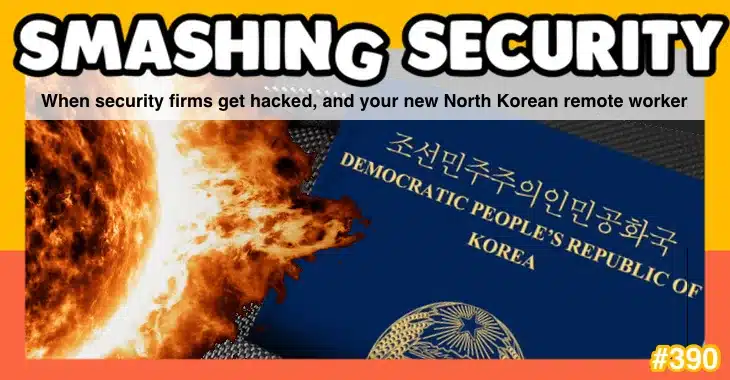
The SolarWinds have returned to haunt four cybersecurity companies who tried to hide their breaches and ended up with their trousers around their ankles, and North Korea succeeds in getting one of its IT workers hired… but what’s their plan?
All this and much much more is discussed in the latest edition of the “Smashing Security” podcast by cybersecurity veterans Graham Cluley and Carole Theriault.
Warning: This podcast may contain nuts, adult themes, and rude language.
Show full transcript ▼
 This transcript was generated automatically, probably contains mistakes, and has not been manually verified.
Doesn't look that good.
Hello, hello, and welcome to Smashing Security episode 390. My name's Graham Cluley.
But it was terrific being there and meeting some fans of the pod as well. Hope you enjoy your stickers.
Over 425 of the US Fortune 500 are using their software.
That means the top 10 US telecoms companies, all branches of the US military, the Department of Justice, the US President's Office, the top 5 accounting firms, Microsoft, Intel, Google, the list goes on and on and on.
And their problems began when some of their developers left their GitHub repository, the place where they put in their source code.
They left it open to the public, to the entire world, which isn't a good idea, is it?
Well, it can be all right leaving your source code open, but maybe not if your source code includes a hardcoded plaintext password for one of your company's update servers.
That's not so good, is it? Not so wise.
And— So SolarWinds, they took an interesting approach when they were challenged about this. In fact, a member of Congress Katie Porter.
She went viral briefly when she spoke to SolarWinds CEO about the password.
I've got a stronger password than SolarWinds123 to stop my kids from watching too much YouTube on their iPad.
That's gross. It's really gross.
And that malware was installed via the booby-trapped SolarWinds software update. It then sat around waiting for around about two weeks before doing anything malicious.
And then when it triggered, it disabled all antivirus software and forensic tools to try and stay undetected.
And it started looking for other vulnerabilities to exploit on your network.
And ultimately, as many as 18,000 of some of SolarWinds' 300,000 customers installed this malicious update, and they were now compromised with a remote access Trojan.
Now, 18,000, you may think, could have been much worse.
This is one of the biggest hacks in history, one of the most serious security breaches.
And it wasn't helped, of course, because SolarWinds had been advising customers to disable any antivirus before installing its software. In retrospect, maybe not the best advice.
Maybe not the best advice. Doesn't look that good. Yeah, doesn't look that good.
And I'm sure many companies do this. And it's not smart, you know, because when this happens, it's a real shit show, you know?
And of course, organizations like governments, like big companies, like the US President's office, whatever, they do rely upon security companies and cyber companies pushing out updates And sometimes they will kind of greenlight those updates rolling out.
We saw that with the big CrowdStrike outage earlier this year.
So why am I talking about this today, Graham? Is it that you haven't found any other good stories in the last four years? Well, the reason is because there's been a development.
Cybersecurity firms like Avaya, Check Point, Mimecast, and Unisys have just been fined by the SEC, which says they tried to brush the impact of the SolarWinds hack, the impact that hack had on their companies, under the carpet.
So they were customers of SolarWinds who got affected by this.
They were breached, but they weren't fully transparent about what happened, and they are now facing millions of dollars worth of fines as a consequence.
They tried to sweep it under the rug, hoping no one would notice the giant lump of digital doo-doo that they would hide in there. So it's a bit like hiding a corpse.
I don't know if you've ever hidden a corpse, Carole.
So security company obviously had heard about the SolarWinds breach, didn't recognize that even though it were a customer, didn't recognize that it had actually fallen foul of it till 2021, a whole year later.
They failed to disclose the nature of the code which the hackers had stolen, and the quantity of encrypted credentials they'd accessed as well.
Hope they don't beat you up too much. That's better than doing a cover-up. Unisys, they described the risks of the cybersecurity breach as hypothetical.
No, it's not a hypothetical risk when you're surrounded by flames and fire and lava. It's a bit more than that. But now they are paying the price.
Unisys have been told to pay $4 million in civil penalty, Avea $1 million, Check Point, $995,000. I don't know why they get a $5,000 rebate in that.
Mimecast are gonna have to pay $990,000.
They have access to a lot of information in order to make sure that it's safe.
They're the ones we trust to keep our data safe, and yet they don't seem to know how to handle a security breach themselves.
And it's sad, but I'm trying to think they would want to just skate that line between honesty and keeping everyone calm so they don't have to deal with a huge, you know, employee going crazy and customers going crazy.
It's a bit if granddad dies, right? If granddad dies, it's upsetting to everybody.
But you've got to tell the grandchildren at some point that granddad isn't going to be around anymore. You can't do a weekend at Bernie's and pretend that he's still alive.
An Owl Labs report says that 60+ percent of workers aged 22 to 65 in the States say they work remotely at least occasionally. And that's a huge increase from pre-pandemic times.
And remote workers are also apparently more productive. They attribute it to fewer distractions, reduced commuting time, and a comfortable working environment.
Would you agree with that? Do you think you're more productive in a home environment than you would be in an office environment?
I love working at home, but maybe I love all the distractions and being able to nip out for a walk around the park whenever I rather than having a boss breathing down my neck.
A Gartner survey indicated that 74% of CFOs plan to shift some employees to remote work permanently just to leverage the benefits of diverse and widespread talent.
You know, there's all kinds of big financial reasons why this could be attractive to businesses too.
So all this gives employees more choice over where they can live without having to compromise their careers because they can work from anywhere, while employers no longer need to stop their search for talent at the national borders.
So win-win-win.
When a firm finds an international candidate for a contractor position they have open, and this person has the right profile and the right skill set, it's really smart to get your skates on because that resource won't be sitting on the sidelines for long.
But despite best intentions, things can go wrong and sometimes very, very wrong as it did in this case.
So a company based in either the US, UK, or Australia, they've chosen to be anonymous internationally for reasons that will maybe become clear.
So they find this strong candidate for a position, for an IT position, an IT role, and they go through all the interview hoops and checks to onboard this promising new consultant.
And then, of course, tools, tech, and access is shared, and work begins, and the initial months pass.
And it's sometimes around this point, if you're an employer, that you might realize that the candidate might not work out.
And this might be because despite the employer's best intentions, they're just not a good fit.
That might be work quality is low, or there's poor communication, or they show up naked for a video call and break the rules or whatever.
And the firm seems to have decided to cut its losses and terminate the relationship with the consultant because he wasn't doing the work properly.
And that should have been the end of that, except that following the contractor's dismissal, the company starts receiving emails with attachments containing evidence of stolen data, stolen data from their very own systems.
And then the firm receives an email demanding a six-figure sum in cryptocurrency for the information not to be published or sold online.
Turns out the contractor, or the person posing as the contractor, was actually from North Korea.
This is someone who maybe came into the organization with a certain intention right at the beginning.
The worker stole data and then tried to hold the company to ransom after being fired. Now, it's not new that North Korea workers attempt to secure jobs in the West.
The FBI previously said that there are thousands of North Korean IT workers posing as non-North Korean to get remote jobs in the US in order to funnel money back to the North Korean state.
And there's so much about this, of their attempts to, I mean, this is obviously on a smaller scale perhaps than some of the other hacks which they've attempted, but it is all about getting the cryptocurrency in, isn't it?
But you see, many companies would be prohibited from paying a ransom because of the international sanctions on North Korea.
Is it that they would, for instance, set up a bank account in the US, UK, Australia, and they get paid into that, and then they convert that into cryptocurrency for transportation back into North Korea, perhaps.
No longer are they just after a steady paycheck, they say they're looking for higher sums more quickly through data theft and extortion from inside the company's defenses.
And they recommend that companies implement rigorous identity verification procedures, conduct face-to-face or video interviews, and be vigilant for suspicious requests, such as efforts to redirect corporate IT equipment to a purported home address.
Whether it be on a Zoom call or less likely, perhaps these days, doing it across a desk, who passes the interview. Oh, thank you. You're absolutely wonderful.
And then the North Korean chap takes over for the actual hacking and the exfiltration of the data.
Employees can be scammed, right, by fake companies that are trying to get their details, and employers can be scammed by fake employees.
So, you know, employees are told to be very careful about sharing details with new companies until they're completely sure the company's legit.
I've seen advice like check the company has a legit website, check that it has a company email address, check its LinkedIn profile. These are all easy to create illegitimately.
And while these additional steps are necessary, it hampers good people from finding good jobs at legit organizations. Do you see what I mean?
Because both sides are going, verify your identity, send me your passport, send me your banking details. And the employee's like, no way, are you mad? Show me you're legit.
No, we're not doing this. You're just too hard to work with. You know, we wanna be your, we wanna be a bit more relaxed, guys.
Something like 70% are saying they're looking for new work because of it.
So, you know, I don't know, I guess the advice is take heed.
Vanta automates compliance for SOC 2, ISO 27001, and more, saving you time and money while helping you build customer trust.
Plus, you can streamline security reviews by automating questionnaires and demonstrating your security posture with a customer-facing trust center, all powered by Vanta AI.
Over 7,000 global companies like Atlassian, FlowHealth, and Quora use Vanta to manage risk and prove security in real time. Get $1,000 off Vanta when you go to vanta.com/smashing.
That's vanta.com/smashing for $1,000 off. Quick question: do your end users always, and I mean always without exception, work on company-owned devices and IT-approved apps?
I didn't think so. So my next question is, how do you keep your company's data safe when it's sitting on all of those unmanaged apps and devices?
Well, 1Password has an answer to this question, and it's called Extended Access Management.
1Password Extended Access Management helps you secure every sign-in for every app on every device because it solves the problems traditional IAM and MDM can't touch.
Go and check it out for yourself at 1password.com/smashing. That's 1password.com/smashing. And thanks to the folks at 1Password for supporting the show. And welcome back.
Can you join us at our favorite part of the show, the part of the show that we like to call Pick of the Week.
Could be a funny story, a book they've read, a TV show, a movie, a record, a podcast, a website, or an app, whatever they wish. It doesn't have to be security-related necessarily.
The documentary is called Undercover: Exposing the Far Right.
And this was a fascinating documentary film I watched last night following the work of the campaigning anti-fascist organization Hope Not Hate and their members track down far-right extremists, go undercover, and infiltrate organizations.
Wow. And this is the first time Hope Not Hate has allowed cameras to follow its undercover team.
And I found it really interesting because it's easy to think of far-right protesters in stereotypical terms, right?
I imagined someone, you know, a bit skinheaded, angry louts marching around shouting abuse at people who aren't white.
But one of the things that came across to me while watching this documentary is the puppet masters of the movement, the people at the top, who in some cases were sort of Cambridge University educated, very well spoken, who weren't necessarily beating up people on marches, but instead were trying to form an elite group of people obsessed with eugenics, with the potential to influence people in power.
And in this particular investigation, these people were looking for like-minded millionaires to fund their right-wing racist agenda.
And so we had this young journalist, Harry Shookman. He went undercover. He'd never used a hidden camera before. But he went undercover.
He posed as someone who'd come into a lot of cash and was looking to invest it.
And he pretended to be racist and tried to find out more about how this far-right group was operating and structured, what they're up to.
And crucially, and critically, who their mystery other mega-million tech investor was. So there was someone else who had also put a lot of money behind this particular movement.
And of course, we recently had an outbreak of racist riots in the UK, which this movie covers as well.
And this organization, Hope Not Hate, helped identify some of the people behind that. So, really interesting documentary. As I said, I watched it on Channel 4 streaming in the UK.
It was supposed to be shown in the last few days at the London Film Festival, and it was pulled at the last moment due to safety concerns because threats had been made.
From, you can imagine, the usual suspects about the airing of this documentary. Anyway, I would recommend it. Really good documentary, which was quite enlightening.
And that is why Undercover: Exposing the Far Right is my pick of the week. Not a lot of laughs there, Carole, I'll be honest with you.
But even more chilling than The Exorcist is the BBC documentary that I watched last year about the making of The Exorcist. The Fear of God: 25 Years of The Exorcist.
This is with Mark Kermode. He's a talented and engaging UK-based film and culture critic. The documentary blew my mind because a lot went wrong in the making of the film.
And if you watch the film, it is scary, right? And you're "She looks petrified." And when you watch the documentary, you realize that, yes, she really was, and you realize why.
But as a bonus, I've also put a link to a short 8-minute essay on The Exorcist from Mark Kermode's podcast, Kermode and Mayo's Take. It's a great resource for film buffs.
There's 500 episodes or more, so they're podcast veterans us, Clue.
Have you seen Doctor Who and the Seeds of Doom? No. Plants taking over the world. It's really scary. Well, that just about wraps up the show for this week.
You can follow us on Twitter @SmashingSecurity, no G, Twitter and mouse, type a G.
And don't forget to ensure you never miss another episode, follow Smashing Security in your favorite podcast app, such as Apple Podcasts, Spotify, and Pocket Casts.
Episode show notes, sponsorship info, guest list, and the entire back catalog of more than 289 episodes. Sorry, back catalog of more than 389 episodes.
Check out smashingsecurity.com.
Hosts:
Graham Cluley:
 @grahamcluley.com
 @
@
 / grahamcluley
Carole Theriault:

Episode links:
- SolarWinds Sunburst supply chain attack – Wikipedia.
- Rep. Katie Porter slams SolarWinds for its poor passwords – Twitter.
- SEC Charges Four Companies With Misleading Cyber Disclosures – SEC.
- Western firm hacked by North Korean cybercriminal hired as remote IT worker – Computing.
- Engaging with a Remote Workforce: Statistics and Strategies for Success – Government Events.
- 67% Of U.S. Employers To Lose Employees To Remote Work In 2024 – Forbes.
- A company’s remote-working hire turns out to be in North Korea. He tried to hold it to ransom – Business Insider.
- US company accidentally hires North Korean for remote work, gets blackmailed when they try to fire him – IBTimes.
- Watch “Undercover: Exposing the Far Right” – Channel 4.
- Undercover film exposing UK far-right activists pulled from London festival – The Guardian.
- Kermode and Mayo’s Take – YouTube.
- The Fear of God: 25 Years of the Exorcist – BBC iPlayer.
- Smashing Security merchandise (t-shirts, mugs, stickers and stuff)
Sponsored by:
- 1Password Extended Access Management – Secure every sign-in for every app on every device.
- Vanta – Expand the scope of your security program with market-leading compliance automation… while saving time and money. Smashing Security listeners get $1000 off!
Support the show:
You can help the podcast by telling your friends and colleagues about “Smashing Security”, and leaving us a review on Apple Podcasts or Podchaser.
Become a Patreon supporter for ad-free episodes and our early-release feed!
Follow us:
Follow the show on Bluesky at @smashingsecurity.com, or on the Smashing Security subreddit, or visit our website for more episodes.
Thanks:
Theme tune: “Vinyl Memories” by Mikael Manvelyan.
Assorted sound effects: AudioBlocks.