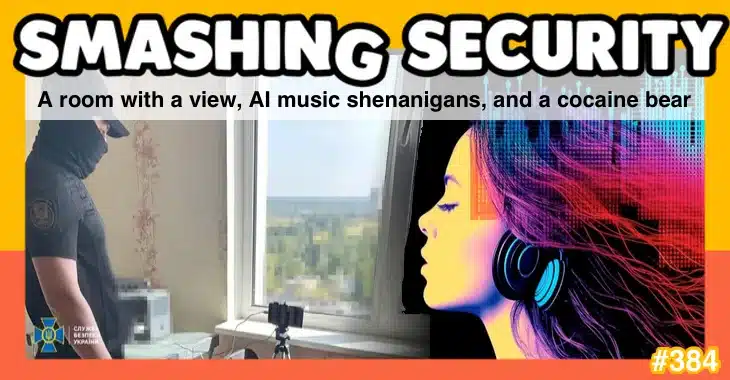
It’s a case of algorithm and blues as we look into an AI music scam, Ukraine believes it has caught a spy high in the sky, and a cocaine-fuelled bear goes on the rampage.
All this and more is discussed in the latest edition of the “Smashing Security” podcast by cybersecurity veterans Graham Cluley and Carole Theriault.
Warning: This podcast may contain nuts, adult themes, and rude language.
Show full transcript ▼
 This transcript was generated automatically, probably contains mistakes, and has not been manually verified.
Hello, hello, and welcome to Smashing Security episode 384. My name's Graham Cluley.
Well, many of us can only dream, can't we, about one day escaping to the country or buying a little place in the sun or a bijou hideaway in the bright lights of the city.
What would be your dream pad, or what would you really desire property-wise one day? What sort of property would you have?
I mean, price is obviously a big factor, right?
If you were buying a penthouse apartment, sounds like you're not, but I'm guessing you'd care about the views as well if you got something like that.
So maybe you'd be after a city skyline that could be spectacular or a lovely waterfront to look at or a historical landmark or perhaps a Ukrainian energy plant.
It seems some people are indeed snapping up high-rise apartments with views of critical infrastructure in that particular war-torn country. Which seems to me a bit of an odd choice.
Do you really want to be near critical infrastructure if Vladimir Putin is lobbing a whole load of missiles and drones towards it?
According to intelligence agencies, authorities in Ukraine, the man decided to rent out the apartments after being offered what was euphemistically called easy money via Telegram.
All you've got to do for us is a little bit of a—
Apparently, the people contacting him via Telegram were Russia's military intelligence service, the GRU. And they recruited the man to install cameras in his apartment.
There was a coffee pot at the University of Cambridge you could check on to see what it was up to. And after a few years, you began to hear about sites like Jennycam.
And Jenny was the world's first cam girl. She had a webcam, which was quite an unusual thing to own in those days, in her dormitory at Dickinson College.
And it automatically took a photograph of whatever was going on in her room every few minutes and broadcast it.
But in those days, I think people were just looking for anything on the internet. It was a bit, I imagine, like watching Big Brother.
You watch the TV show and you would watch them 24 hours a day as they were scratching their bottom or whatever, or organising dinner.
Now, no one else ever subsequently ever had the thought again of live streaming cameras in women's bedrooms.
That definitely isn't a thing, and it wasn't something I suggested to you. At least it wasn't suggested to you in a pervy way or anything like that.
I just simply thought— anyway, the thing is, it hasn't become a phenomenon.
But if you were approached by Russian military intelligence and they asked you if you could put some cameras in your apartment, you might think it was maybe to boost the morale of their troops on the front lines.
And in a statement posted on Telegram, Ukrainian law enforcement have announced they've arrested this alleged Russian spy in Kyiv and that he had installed video cameras with remote access software allowing Russia to monitor Ukraine's critical infrastructure in real time.
And the reason for this, of course, is that the Russian forces wanted to be able to assess the impact of recent airstrikes by accessing the footage and identify anti-aircraft defense systems put in place by Ukraine.
They also seized his phones and video cameras, which contained evidence of what they called intelligence and subversive activities for Russia.
If convicted, let's face it, it's quite likely he will be, if convicted, he faces life imprisonment. And his cameras and phone being confiscated.
Now, I'm not— I think I've got a good idea as to which one's going to bother him more.
But all of this makes me think, we've often worried about CCTV and webcams being hacked by perverts or sextortionists, or hackers exploiting baby cams to spook children.
But surveillance cameras can clearly be abused in other ways as well.
But clearly, sometimes these surveillance cameras are being installed intentionally close to places where there is critical infrastructure. I mean, that's the point, right?
If you've got critical infrastructure to protect, you're probably going to have security cameras.
So you better darn well make sure that they can't be hacked, they can't be accessed remotely, that you've got them properly locked down.
And sometimes these things can actually be technology which has been made in other countries, maybe has vulnerabilities, maybe your government has cut a few corners when it's budgeted for this and hasn't got them properly locked down and hasn't got them properly secured.
And then no one knows what's going on inside.
They said turn them all off, cover them up, as they feared they could be exploited to gather information by Ukraine's forces.
And earlier this year in Ukraine, they found surveillance cameras on residential buildings in Kyiv.
They took them down because they had allegedly been hacked by Russia to spy on air defense forces, critical infrastructure.
You know exactly where who was, where, what they did. Yeah, police love them.
And it's great within a geography until that geography is at war or having fights with someone else, because then obviously it could be hacked.
It's just an interesting weakness I've never thought of, actually.
In this case, at these residential buildings in Kyiv, the cameras had initially been put there to monitor the surrounding area, the parking lot, but the hackers, after gaining access, changed the viewing angles and set them up to stream footage live to YouTube.
Again, probably trying to help direct drone attacks and missiles en route to Kyiv. So, there you go, Carole. Are you going to get a video camera on your doorbell?
Are you going to put one up in your bedroom? I know I suggested it 30 years ago, but—
There are different types of royalties out there. I didn't know this. So in the US, you have mechanical royalties, and that's whenever the song is streamed or downloaded online.
You have performance royalties. This is where the music's publicly performed, on radio or in venues. You have sync royalties or synchronization royalties.
This is where the music is used in visual media, films or TV commercials, video games, YouTube, that sort of thing.
And then you've got print royalties, where it's the sheet music that's sold.
You get an instrument and then you go get, "I want to play Paul Simon's best song" or whatever, right?
So basically, the more downloads or more streams or plays or sales or whatever, the more moolah the royalty holder gets.
And Graham, remember, we used to talk — this is ages ago, but we used to talk about writing a Christmas hit.
Because our thinking was, you know, if it gets picked up and becomes a classic, we can rest on our rich asses for the rest of our days.
And everyone on the planet has the idea of "Oh, if we only wrote a Christmas song, it'd be amazing." But it seems as if you do have the talent, and maybe a dash of luck and a sprinkling of magic, you can make some serious cash in the music industry, our man of the moment here, Michael Smith.
So this 50-ish, your age, Graham, right? A North Carolinian.
He's been living this dream literally, because songs that he's published are getting an enviable glut of listens across all the platforms.
So you've got Amazon Music, Apple Music, Spotify, YouTube, and all these listens translate into royalties.
But this guy, this guy, he's not just getting a tiny bit of royalty. This guy's making it to the tune of $10 million.
Because you'd think even the mainstream press would be piqued by a guy with such musical talent and business acumen as to make that much cash.
It turns out that Michael Smith has published a lot of music. So it's not like one song has gone viral and everyone's listening to it.
It's more his royalties are spread across his music catalog. I mean, fair enough, right? That's a bit Bob Dylan, right? He gets royalties for Mr.
Tambourine Man, and then he also gets them for All Along the Watchtower and whatever else, you know, he's prolific. He has 40 studio albums. That's crazy.
But Michael Smith is even more prolific than our Bob. Okay, because Michael Smith has created hundreds of thousands of songs, Graham. Hundreds of thousands.
Here's a rough outline of the game.
Okay, this is early days in the world and a music promoter to create a lot of songs using AI.
And the music company took it seriously and soon began providing Smith with thousands of songs. Each week that he could upload to streaming platforms.
You be the judge. So instead of having N_782B2D, you have Zygotines, Zygoats, Zygotik, Zygotiklanies, Zygotik Washstands. And that is my favorite. Zygotik Washstands.
Great, great, great. Hundreds of thousands of songs are going out there. Who the hell's listening to this crap? Who would listen to it? It must sound garbage. Of course it's bots.
Of course it's non-human. AI tunes are out there for non-human bots because maybe, hey, bots need entertainment too.
And it seems that thousands and thousands of bot accounts allegedly created by our very own Michael Smith. Oh my God.
They were programmed to go and listen to Michael Smith songs, AI songs, as much as possible. And listen, they did.
Because if he had put out one song and had all the bots listen to that one song, people would be like, who is this new Taylor Swift? But no.
So he had lots and lots and lots of bots listen to lots and lots, lots of songs a little at a time and tried to stay under the radar.
Because of course it's not legal to push out AI music and declare that as human-made or to create fake bots to pretend to be human listeners.
That's taking money from the music companies, isn't it? Or the streaming service.
So Smith, aged 52, has just been charged with all kinds of wire fraud and money laundering conspiracies and is looking at decades in the clink.
Of course, this is— these are all allegations at this point, and Smith is presumed innocent until proven guilty.
The biggest question for me, I think, is what's going to happen to Zygotik Washstands as a name? Does he own the TM for that?
But I heard there was a group who called themselves Local Radio. That was their name.
And they managed to generate money for themselves because whenever people would say to their Alexa, Alexa, play the local radio, it would play that band instead.
And so they got all these accidental plays. And it helped them make money. Isn't it a great— I think it's a really lovely idea.
So my next question is, how do you keep your company's data safe when it's sitting on all of those unmanaged apps and devices?
Well, 1Password has an answer to this question, and it's called Extended Access Management.
1Password Extended Access Management helps you secure every sign-in for every app on every device because it solves the problems traditional IAM and MDM can't.
Go and check it out for yourself at 1password.com/smashing. That's 1password.com/smashing. And thanks to the folks at 1Password for supporting the show.
Modern threat actors have weaponized cloud automation to accelerate, taking only 10 minutes to fully execute an attack in the cloud.
As organizations continue to shift into larger and more complex cloud estates, legacy detection and response frameworks are no longer sufficient at stopping cloud attacks.
Well, Sysdig delivers fast and effective multi-cloud detection and response, or CDR, capabilities to empower analysts against these accelerated and complex cloud threats.
Powered by Falco, analysts gain the visibility, context, and real-time security capabilities traditional EDR on-prem tooling fail to deliver.
Learn more about how to stop advanced attacks at cloud speed. Visit smashingsecurity.com/sysdig for more information. That's smashingsecurity.com/sysdig.
And thanks to Sysdig for supporting the show.
Whether you're starting or scaling your company's security program, demonstrating top-notch security practices and establishing trust is more important than ever.
Vanta automates compliance for SOC 2, ISO 27001, and more, saving you time and money while helping you build customer trust.
Plus, you can streamline security reviews by automating questionnaires and demonstrating your security posture with a customer-facing trust center, all powered by Vanta AI.
Over 7,000 global companies like Atlassian, FlowHealth, and Quora use Vanta to manage risk and prove security in real time. Get $1,000 off Vanta when you go to vanta.com/smashing.
That's vanta.com/smashing for $1,000 off. And welcome back, and you join us at our favorite part of the show, the part of the show that we like to call Pick of the Week.
Could be a funny story, a book that they've read, a TV show, a movie, a record, a podcast, a website, or an app. Whatever they like.
It doesn't have to be security related necessarily.
But I have recently dug out my old Kindle and I've been reading ebooks and enjoying them.
And I remembered you talking about this Libby app because I'm a member of the library and I thought, oh, I don't really want to spend loads of money.
So I thought maybe there's some ebooks I can read for free. Now, in America, I believe via Libby, you can send an ebook which you borrow from your library to your Kindle device.
And what I found is that for some reason, that doesn't work in the UK. You can't send your Libby-borrowed book from the library to your UK-based Kindle.
So I went and bought myself another e-reader. So my old aging e-reader has been consigned to someone else. And now I have the Kobo Clara BW, which is a Kindle, really.
Okay, I don't find it that different from the Amazon Kindle myself, but the beauty is that it's all integrated with the Libby app by something called OverDrive, which means that I can now take out from my local library from the comfort of my e-reader.
And the wonderful thing about this e-reader for me compared to my old one is it has a night mode. So when I'm reading in bed, and the lights are out, I can actually read.
I don't have to have a great big bright screen in front of me.
Now I get white writing on a black background at night. You with me?
So I have got the Kobo Clara BW, and that is my pick of the week. And thank you, Carole, for recommending the Libby app all those months ago.
And it was evening and I was chilling out with my cousin and we didn't want to go out because it was too gross. So we do what we all do.
We made some simple, cozy, you know, goopy food and perused some of the streaming channels.
You know how sometimes two people together come up with something that neither individual party would have watched on their own?
Well, it happened to us because I ended up watching Cocaine Bear, which is my pick of the week. Please tell me it's not a finished show.
A drug smuggler wants to drop a shipment of cocaine by plane by parachuting out with a drug-filled duffel bag. That's his plan, right?
But somehow knocks himself out on the plane's doorframe on his exit and sadly falls to his death in Knoxville, Tennessee.
A black bear finds the cocaine, munches on it, goes insane, chasing and mauling folks in a rather grisly manner, all in the desperate need to get more of his fix.
Of course, the drug dealers that are connected with the guy who died are also trying to find where the hell their cocaine has gone. And did the guy do a runner? And what's going on?
And the cops are there and the rangers are there because they keep getting reports of missing people in the area.
You've got TV stars like Keri Russell from The Americans, Isaiah Whitlock from The Wire, Margo Martindale from everything political in the world, and the late Ray Liotta is even in it.
It's just ridiculous. It's wonderful. It's horrible. It's got a pinch of gore. It's wildly entertaining. We both totally loved it.
And a weird factoid, it is loosely based on a true story.
There was no murderous rampage by a bear in the true story, but investigators finally found the corpse of a 175-pound male bear and 3 to 4 grams of cocaine in his bloodstream.
And can you guess what the world nicknamed him? This big bear?
And don't forget to ensure you never miss another episode. Follow Smashing Security in your favorite podcast app, such as Apple Podcasts, Spotify, and Pocket Casts.
For episode show notes, sponsorship info, guest list, and the entire back catalog of more than 383 episodes, check out smashingsecurity.com.
Hosts:
Graham Cluley:
 @grahamcluley.com
 @
@
 / grahamcluley
Carole Theriault:

Episode links:
- Ukrainian detained for allegedly installing CCTV cameras to aid Russian attacks – The Record.
- Russia calls for restrictions on surveillance cameras, dating apps in cities under attack from Ukraine – The Record.
- Christo and Jeanne-Claude art projects.
- North Carolina Musician Charged With Music Streaming Fraud Aided By Artificial Intelligence – United States Department of Justice.
- Man Arrested for Creating Fake Bands With AI, Then Making $10 Million by Listening to Their Songs With Bots – The Futurist.
- Kobo Clara BW ereader – Kobo.
- Cocaine Bear: Why? – The Atlantic.
- Cocaine Bear Official trailer – YouTube.
- Smashing Security merchandise (t-shirts, mugs, stickers and stuff)
Sponsored by:
- 1Password Extended Access Management – Secure every sign-in for every app on every device.
- Sysdig – Secure your cloud in real time. Detect, investigate, and respond to threats at cloud speed.
- Vanta – Expand the scope of your security program with market-leading compliance automation… while saving time and money. Smashing Security listeners get $1000 off!
Support the show:
You can help the podcast by telling your friends and colleagues about “Smashing Security”, and leaving us a review on Apple Podcasts or Podchaser.
Become a Patreon supporter for ad-free episodes and our early-release feed!
Follow us:
Follow the show on Bluesky at @smashingsecurity.com, or on the Smashing Security subreddit, or visit our website for more episodes.
Thanks:
Theme tune: “Vinyl Memories” by Mikael Manvelyan.
Assorted sound effects: AudioBlocks.