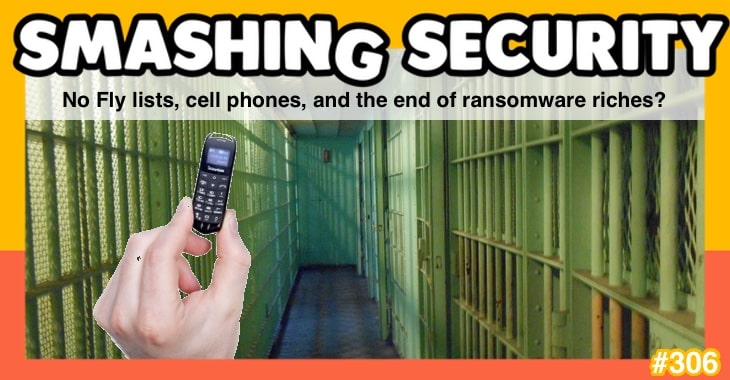
What are prisoners getting up to with mobile phones? Why might ransomware no longer be generating as much revenue for cybercriminals? And how on earth did an airline leave the US government’s “No Fly” list accessible for anyone in the world to download?
All this and much more is discussed in the latest edition of the award-winning “Smashing Security” podcast by cybersecurity veterans Graham Cluley and Carole Theriault, joined this week by Maria Varmazis.

Show full transcript ▼
 This transcript was generated automatically, probably contains mistakes, and has not been manually verified.
Hello, hello, and welcome to Smashing Security episode 306. My name's Graham Cluley.
Now, coming up on today's show, Graham, what do you got?
Have you thought about writing a book?
So nobody has to do the, how's your novel coming along?
And then we challenged ourselves and we both wrote one about senior members of staff at Sophos.
He wore his great power and wealth lightly. Nothing gave him as much joy as seeing the faces of the children he helped save.
As an ex-member of the British Olympic badminton team, women fantasized about him lifting them into his arms and carrying them to a large silk-draped bed.
His simple gray suit hid a body of pink steel with a taut chest that rippled as his perfect ass made women stifle.
But anyway, I've always wanted, I've always thought, wouldn't it be wonderful to write maybe my memoir? Maybe, you know, my struggle, you know, how a young lad—
There's constant distraction.
Writing a book and you're not going to make any money out of it. You know, just—
You can spend hours in the privacy of your room, not being disturbed by children, not distracted. You don't have to worry about paying your bills.
You don't have to think, oh, I've spent too long at Waitrose, you know, popping out to the shops, doing things other than writing. It is the perfect place to be.
It is, of course, prison. If you go to prison, they lock you up for hours and hours, 23 hours a day. In a cell.
They've taken a close look at the use of cell phones behind bars. Behind prison bars.
I looked up on Amazon, there's a phone called the Zanco Teeny Tiny T1.
But it's known as the BOSSBeater because it's designed to beat a body orifice security scanner known as the BOSS. You can listen to music, albeit muffled.
You can text with your friends. You can make calls. But it's so tiny, this thing. I mean, it's about the size of your ear.
Because you hold it up to your ear with its tiny little speaker.
I wonder whether you're also covering the microphone, which is meant to be your mouth, whether you're constantly sort of sliding it back and forth. I don't know.
But it is presumably, as we've already said— well, as you've said, Maria, rather grubbily— it is probably fairly easy to smuggle into a prison, albeit somewhat uncomfortable.
It's the outside world that they want to talk to, isn't it? Because of course you might still—
You have to sort of— you're only allowed to call certain people your brief or your mole outside.
But the thing is that the phone calls are being monitored and supervised for understandable reasons.
And some are using these just to stay in touch with their families, which is understandable because you would be worried. I would be worried.
You know, I might call up the dog, see that he's doing okay. I might call up my child. I might just want to check they've done their homework or something.
So I'd give, you know, I'd give someone a bell.
So you might want it for legitimate reasons and simply not be restricted to the times when you're allowed to use the phone and who you're allowed to call.
But also, people are using their mobile phones in prisons, especially in America, to traffic guns and drugs. And even sextortion scams are being operated from inside prison.
You know, these scams where they pretend to be naïve young women and get you to take your clothes off and do things in front of them.
Because he was a very good writer. So he would actually— other prisoners would pay him, and he would do a Cyrano de Bergerac thing.
I heard of one guy who was on death row, and he was making threatening calls to a Texas state senator, saying, you know, we're gonna kill you, mate.
So they say that some people are smuggling contraband phones into the prison to take public Harvard classes. So they're actually—
So maybe, you know, Jimmy Fingers, you just got slashed down in the showers.
So if you've got a gaping wound and you don't want to go to the Rozzers or the Nurks, what's the phrase for prison guards? I don't know.
They're doing first aid and they're using YouTube and TikTok to develop new skills. You know, it's wonderful really, isn't it?
Now, one guy was able to FaceTime his mum before she passed away. I mean, that's a great thing, isn't it? Aw. Isn't that lovely?
Some of them have actually smuggled in smartphones, of course, which include voice dictation. Might be a bit quicker, maybe. I don't know. But this is what's going on.
This is what's going on. Some are taking online classes. Some are participating in Zoom classrooms. So—
You say to the boss, oh yeah, yeah, as long as I get the work done, you know, don't worry about the hours I do, I'll get the work done.
And you either farm it out to Fiverr or something and get someone in Indonesia to do the work for you, or you have about 3 or 4 different jobs on the go at the same time.
You're employed by all these different companies and you say, yes, yeah, I'm there. You just got different windows open.
Well, some of these guys in prison apparently are doing online gig work. So maybe they're helping the rest of us.
If there was some way to get people to use this for good rather than bad and not engage in the bad stuff, maybe we just need Net Nanny.
Maybe we just need more surveillance as to what people are doing. I don't know. What would you do if you had a life sentence and an internet connection, Maria Varmazis?
A person who goes by the name of— okay, I'm gonna get this name incorrect, hold on a second— Maya Arsen Crimeu is a Swiss hacker and used Shodan to scan unsecured servers on the internet, as one does with Shodan, because that's what Shodan does, and happened to find an unsecured server run by the U.S.
national airline Commute Air, which I have never heard of, but they must be a smaller provider.
And it includes names and birthdates, multiple aliases for some people who may be trying to evade the government. This is the official— Jesus, Webb. —U.S.
government terrorist screening database, and the official U.S.
government no-fly list, which has been extremely controversial in the United States for the past 20-plus years, by the way, but it ballooned in size ever since 9/11 for probably very obvious reasons.
I actually have not gone to look to see if someone has put this CSV online, although maybe we could just go find— we could just go on Shodan right now and be like, "Hey, no-fly to CSV!" Graham wants to Google his name, you see.
I remember that— in fact, Maria, we all three of us worked at a company where a certain person who worked in the virus lab shared the name with someone who was on the do-not-fly list.
It's a big problem if you're flagged and you just— there's really no recourse for you if you feel like you've been incorrectly included. It's a big problem. Yeah.
So according to Crimeu, who's— by the way, their website is maya.crimeu.gay. Amazing, just amazing URL.
That apparently a lot of the people on the list, their names were of obvious Arabic or Middle Eastern descent. There are some names that are Hispanic or Anglican sounding.
But there are also a lot of Russian-sounding names. I don't know what we want to do with that information, but it's just interesting, I guess. Yep.
And apparently the TSA says it is, quote, aware of a potential cybersecurity incident with Commute Air, and we are investigating in coordination with our federal partners.
And further investigation showed that this no-fly list is apparently from 2019. So it's a few years old.
So my gut says, okay, you'll tell me if I'm right or wrong, maybe you'll know, but I guess there's an employee who could have a little cut and paste while they are working for the TSA, and now they find themselves working at CommuteAir and just plopped it in the database as their kind of welcome gift for hiring them.
And it's just basically using Shodan, looking for exposed Jenkins servers, all of a sudden, doink! What is this file? Oh my God, look at this.
Apparently a lot of the process in the blog post was actually trying to find journalists who'd be interested in this story.
And a lot of them did not understand what Maia Crimew was trying to tell them, which is hilarious.
The no-fly list had just, I believe, names and birth dates, which again, not a small thing either.
But yeah, all sorts of other sensitive information was also wide open to the internet. I mean, it's really a hacking story if it's just yet another bucket misconfig.
It is, but it's oh my God. No, I know, but it keeps us employed, I guess.
They kind of just left something, but they didn't leave it out front. Someone had to go, you know, it's I left it in my back garden in the corner off to the side.
I mean, keep it on the cloud in CSV form with no protection.
Maybe their internet went down at some point and they're like, well, we can't fly unless we have this list, so we better have a local backup. Like, I could totally see that.
I mean, if you had to access some sort of shared resource and you were— if you were a baddie getting onto a plane and you realize you're on the do not fly list, then the thing to do is to DDoS the do not fly server, I suppose, isn't it?
So people wouldn't be able to access it to look you up. So I guess people must have access to this data somehow.
Said, so while the nature of this information is sensitive, I believe it is in the public interest for this list to be made available to journalists and human rights organizations.
So if you are a journalist, researcher, or other party with legitimate interest Please reach out to .
I will only give this data to parties I believe will do the right thing with it. Alternatively, the data is now available for access upon request via DDoS Secrets.
So the TSA knows now. They know. Yeah. No, I know.
I mean, yeah, it is, I mean, again, expose server to the wide open internet, like it's, ah, but at the same time, I mean, these things happen and it happens a lot.
And I guess this is a better outcome than someone going, I'm just going to put it on Pastebin, go nuts.
You know, sometimes I get emails from people saying, would you like the contact details of 50,000 people who are interested in a particular product or something like this?
Would you like this mailing list?
And I'm thinking, if I ran a multinational evil conglomeration, and I wanted to get together all the baddies around the world for some mega conference, probably underneath a volcano, then this is the kind of list which I would really like.
This would be fantastic, wouldn't it?
You'd have to figure out the best time to do it when it was quiet and the security guy was having a poop or something.
You'd have to cover your face to make sure no one could see you to describe you.
You have to scare people into cooperating, hoping to God that in 30 seconds you'd have a fat bag of money and you'd be diving in your getaway car peeling out.
Yeah, it's not for the faint-hearted.
Unlikely but not guaranteed, but much less likely.
Yes, because had you asked me last year, I would have said that based on the fact that everyone's putting every digital thing they've ever done online in a cloud somewhere to keep, from nudes to prescriptions to photos to everything, it seems inevitable that ransomware is going to continue to plague both the lowly user and enterprises and companies and hospitals and all that.
However, according to Chainalysis, this is a company that claims to be the blockchain data platform, they recently shared some ransomware findings and it's receiving more than its fair share of press because the news is rather surprising.
Cybercrime gangs have had a 40% drop in earnings in 2022. That's huge. So in 2021, extortions were estimated at $765 million, whereas 2022 was estimated at $460 million. 40% drop.
So why? Sadly, it's not because ransomware has had its heyday. Despite the drop in revenue, the numbers of unique ransomware strains in operation have reportedly exploded in 2022.
But despite this so-called explosion, there's a strong whiff of affiliations in the ransomware world.
So while dozens of ransomware strains may technically have been active throughout 2022, many of the attacks attributed to these strains seem to be carried out by the same people.
Microsoft security researchers back this up by analysis on similarities between attacks of different strains. And saying, look, how they're carried out is very, very similar.
Must be the same people behind it.
So in other words, there's loads of strains but it's being administered by a small group of folks.
But in February, following Russia's invasion of Ukraine, the Conti team publicly announced its support for Vladimir Putin's government.
Soon after, a cache of Conti's internal communications leaked and indicated connections between the cybercrime organizations and the FSB, the Russian Federal Security Services.
Okay. Ipso facto, many ransomware victims and incident response firms decide that that paying Conti attackers was too risky as the FSB is a sanctioned entity.
So Conti basically eventually responded by announcing its closure, right? So they just said we're not doing any more.
Conti's closure drove many affiliates or people to conduct attacks for other ransomware strains where ransom victims were more likely to pay because people weren't paying with these ones and notably not tied to the FSB as they could see.
But because the people reused the same wallets, Chainalysis are able to better understand the ransomware ecosystem. So it all kind of makes sense. You're following me? Yep.
I'll tell you what I don't understand is if you are saying that Conti stopped getting ransomware payments because organizations didn't want to pay criminal organization associated with the FSB.
Wouldn't it be in the interests of the US authorities, for instance, to name lots of other ransomware groups as being affiliated with the FSB as well?
And people wouldn't pay them either. Why not claim that they're all working for the Kremlin?
So they're using the wallets as a way to link the people who are behind it.
They say the upshot of all this is that it may be more productive to think of the ransomware ecosystem not as a collection of distinct different strains, but instead of a small group of hackers who rotate brand identities regularly.
So they basically just rebrand them.
Wow. So he says it's the same criminals, they're just repainting their getaway cars. Fascinating. Wow.
I thought it was just a huge wide web of thousands upon thousands and they were all just casting wide nets. I would not have thought just a couple of hundred.
You have also ransomware researchers looking at the actual nuts and bolts inside the code to see how they're operating, how they're encrypting, how they're working, whether it's a service, whatever, whatever.
And you put those things together, you get a much different picture of what's going on. And that's kind of cool. So yeah, interesting reading.
I mean, I can understand why Boris Johnson might need to keep on having dodgy loans given to him, but I mean, just what are they gonna do with all of this money?
Even if their numbers have gone down by 40%, which—
Now, that allowed hackers to steal customers' password vaults, and unfortunately there were parts of those password vaults which were astonishingly unencrypted.
There's no doubt a lot of questions users are going to ask LastPass about how that could have happened and why some of that data was left in that insecure state, but one password manager that isn't making that mistake is our sponsor Bitwarden.
Customers of Bitwarden know that their vaults are entirely end-to-end encrypted with zero-knowledge encryption, including, unlike LastPass, the URLs for the websites which you have saved passwords for.
You can learn more about that in the Bitwarden Help Center and at bitwarden.com/privacy.
And if you happen to be looking to switch password managers right now, well, Bitwarden makes it easy.
They support importing from lots of other solutions, and there's even a LastPass migration guide available. Learn more at bitwarden.com/migrate. That's bitwarden.com/migrate.
And stay safe. Today's podcast is also brought to you by NordLayer. Now, NordLayer safeguards your company's network, but it's much more than just a VPN for business.
As you already know, business networks today are more vulnerable than ever due to remote work, ransomware attacks, data leak incidents.
Well, NordLayer secures and protects remote workforces as well as business data, and it can even help you ensure security compliance.
Simply go to nordlayer.com/smashing and get 1 month free. NordLayer is easy to start as it takes less than 10 minutes to onboard your entire business on a secure network.
NordLayer is easy to combine as it's hardware-free and compatible with all major operating systems.
And finally, NordLayer is easy to scale as you can choose a plan unique to your business requirements and your rate of growth.
So if you want to secure your business network, go to nordlayer.com/smashing to get your first month free. And thanks to NordLayer for supporting the show.
Over 80% of all breaches occur when bad guys get their hands on the credentials of critical resources.
Well, an efficient way to combat threats is using a Privileged Access Management, or PAM, solution.
An enterprise PAM tool like ManageEngine PAM 360 offers a holistic picture of all the privileged devices, users, and credentials in your IT infrastructure.
ManageEngine is part of Zoho that offers IT management solutions to over 280,000 enterprises around the world, so you're in good company.
PAM360 is a fully functional Privileged Access Management suite that is easy to adopt and implement.
From managing and governing access to all your enterprise resources to automating the access management lifecycle in your organization, PAM360 does it all.
It's also recognized by the Gartner Magic Quadrant.
Additionally, PAM360 offers excellent round-the-clock support for all customers and onboarding assistance for enterprises that need fine-grained customizations.
PAM360 is the solution for value-oriented enterprises looking to achieve world-class Privileged Access Management without making a dent in their IT budget.
Find out more and see for yourself at smashingsecurity.com/pam360. Smashingsecurity.com/pam360. That's smashingsecurity.com/pam360. And welcome back.
Can you join us at our favorite part of the show? The part of the show that we call Pick of the Week.
Could be a funny story, a book that they've read, a TV show, a movie, a record, a podcast, a website, or an app, whatever they wish.
It doesn't have to be security-related necessarily. Better not be. Well, my pick of the week this week is not security-related.
It is a particular niche form of pornography, which I'm interested in, which I'm going to explain. All right. Yeah.
So the particular branch of pornography I'm most interested in is property porn, which is—
But yes, no, I'm talking to you today about property porn. And I've been— I've got a dirty little secret, ladies and gentlemen.
When I'm on my exercise bike lately, I've been watching a TV show. It's— I mean, you know, it's not high culture. It's called Luxe Listings Sydney. And it's on Amazon Prime. Yeah.
Yes. Amazon Prime. Yes. Yep. Luxe Listings Sydney.
Rather than running some sort of dodgy scam from my prison cell, instead I'm on my exercise bike watching Luxe Listings Sydney. On my tiny little teeny Z1 phone. It is—
He is someone who's helping people buy houses. And there's also two real estate agents, Dillian Lewis and Gavin Rubinstein.
And it's all fast cars, flashy cars, you know, flashy suits, complete wankers. It's just— Maybe I should restart that sentence.
I'm looking around, the properties I'm looking at don't really compare with these. But I'm quite enjoying it. I find it quite enjoyable.
And so I am watching, and I'm not ashamed to say it, I am enjoying Luxe Listings Sydney on Amazon Prime. And it is my pick of the week.
Oh, I can't mention any of them because they're all trash I watch when I'm on my bike. I'm not even joking.
I was, I can't, 'cause they're all just stupid reality TV that I can sort of zone out to while I'm biking.
But yeah, I'm just like, that's not something I would just sit down and watch, but I'm on my bike, I'm— yeah, I absolutely— yeah, why not?
I just— anyone who wants to buy a house for $100 million because, oh, we definitely need 50, you know, a 5-bedroom house for the dog.
You get someone else to do it all for you.
His name is Matt Shearer, and he is— he's a local reporter here in the Boston area for a really old-school radio and TV station called WBZ.
So it's the old grandfather of TV and radio around here.
And he's a young reporter, and he has gone viral a gajillion times on TikTok for his hilarious videos about all the weird quirks and foibles and strange characters in the area where I live in Massachusetts.
And he's got— it's one of those things where if you've ever been to this area, you might recognize some stuff, but if you haven't, you would go, is any of this real?
And I can assure you that it is. And he's just got this knack for making these really funny minute-and-a-half videos that are just brutally funny with a very weird sense of humor.
There's a really famous one he did about 3 Market Baskets within on the same street.
The Market Basket is our supermarket chain up here that people are religious about, myself included. It's a whole thing.
He also has a very famous video about how the town of Stowe lost its only Dunkin' Donuts and the entire town was in mourning not having a Dunkin' Donuts.
It's really like that around here. And his videos are super funny. So yeah, Matt Shearer at WBZ. I think his Twitter account is @MattWBZ.
But if you've ever seen a video that's gone viral about something stupid in Massachusetts, it's probably him who made it.
And I was like, oh, he just went to my hometown. That's amazing.
So my pick of the week is a Netflix miniseries called Hot Skull. Have either of you seen it?
I know, I know, I know. It's called ARDS, A-R-D-S, okay? And the main symptom is the people infected speak nonsense, okay? They are called jabberers.
The virus is spread via the jabberer, okay? If someone who doesn't jabber is exposed to a jabberer's speech, they would become infected.
So to protect themselves, people around wear ear muffs, noise-cancelling headphones throughout the streets of Istanbul.
But when he's exposed, he tests himself by listening to tapes of Jabber, and his head spikes in temperature, but he recovers, and he never jabbers. Hence, hot skull. Oh, right. Okay.
Okay? Gets a hot skull. So, he is hunted by those in power, of course, 'cause he's known as the one who, you know, is immune.
But he wants to elude them 'cause he wants to search for the secret of his hot skull. It's frickin' fabulous. I loved it. It's a miniseries. It's on Netflix. It's great.
It shows you what a lot of imagination and heart can create. I'm gonna—
And I'm actually wondering if I can watch it in the US. It might not be available. And that might be why I've never heard of it.
What's the best way for folks to do that?
And of course, I'm on the CyberWire and I'm doing— I'm the space correspondent. Darknet. So if you listen to the CyberWire, you can hear me there as well.
Smashing Security also is on Mastodon. We love it too. You can find us most easily by going to smashingsecurity.com/mastodon and that will redirect you to our account.
And look, check up the Smashing Security subreddit on Reddit and don't forget to ensure you never miss another episode.
Follow Smashing Security in your favourite podcast app, such as Apple Podcasts, Spotify, and Google Podcasts.
It's thanks to them all that this show is free.
For episode show notes, sponsorship information, guest list, and the entire back catalogue of more than 305 episodes, check out smashingsecurity.com.
Do you know, Maria, I was looking for the show notes for this episode and I mistyped and I didn't notice because your name, you did episode 36 with us on the 3rd of August, 2017.
Oh my God, are you serious? Yes, and your topic was Flash. Oh, Flash, what is Flash? It's not dead yet.
Hosts:
Graham Cluley:
 @grahamcluley.com
 @
@
 / grahamcluley
Carole Theriault:

Guest:
Maria Varmazis:
Episode links:
- The Complete Idiot’s Guide to Writing Erotic Romance – Amazon.
- The Many Ingenious Ways People in Prison Use (Forbidden) Cell Phone – The Marshall Project.
- How Did They Run an Elaborate “Sextortion” Scam From Prison? Cellphones – The Marshall Project.
- Alarm Over Death Row Cell Phone Threats – CBS News.
- U.S. airline accidentally exposes ‘No Fly List’ on unsecured server – Daily Dot.
- Cyber-crime gangs’ earnings slide as victims refuse to pay – BBC.
- Ransomware Revenue Down As More Victims Refuse to Pay – ChainAnalysis.
- Leaked Ransomware Docs Show Conti Helping Putin From the Shadows – Wired.
- Luxe Listings Sydney trailer – YouTube.
- Luxe Listing Sydney – Wikipedia.
- Matt Shearer WBZ – Twitter.
- Hot Skull – Netflix.
- Smashing Security merchandise (t-shirts, mugs, stickers and stuff)
Sponsored by:
- Bitwarden – Bitwarden vaults are end-to-end encrypted with zero-knowledge encryption, including, the URLs for the websites you have accounts for. Migrate to Bitwarden for a more secure password manager.
- ManageEngine PAM360 – A fully functional privileged access management suite that offers a holistic picture of all the privileged devices, users, and credentials in the IT infrastructure. From managing and governing access to all your enterprise resources to automating the access management life cycle in your organization, PAM360 does it all.
- NordLayer – NordLayer safeguards your company’s network, securing and protecting remote workforces as well as business data. It can even help you ensure security compliance. Get your first month free.
Support the show:
You can help the podcast by telling your friends and colleagues about “Smashing Security”, and leaving us a review on Apple Podcasts or Podchaser.
Become a supporter via Patreon or Apple Podcasts for ad-free episodes and our early-release feed!
Follow us:
Follow the show on Bluesky at @smashingsecurity.com, or on Mastodon, on the Smashing Security subreddit, or visit our website for more episodes.
Thanks:
Theme tune: “Vinyl Memories” by Mikael Manvelyan.
Assorted sound effects: AudioBlocks.