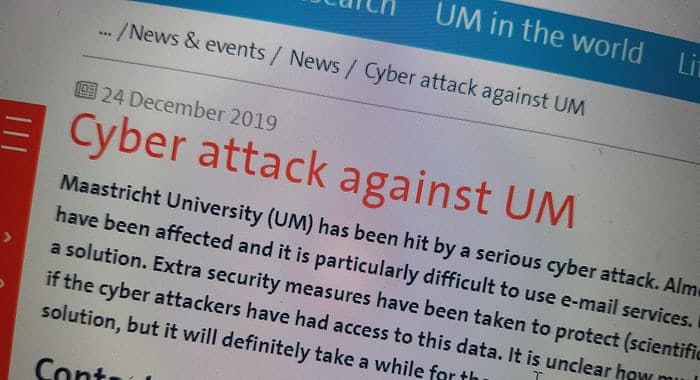
A hacked university might have made a profit after paying a cryptocurrency ransom, China suffers possibly the biggest data breach in history, and Reuters investigates digital mercenaries.
All this and much more is discussed in the latest edition of the award-winning “Smashing Security” podcast by cybersecurity veterans Graham Cluley and Carole Theriault, joined this week by The Cyberwire’s Dave Bittner.

Show full transcript ▼
 This transcript was generated automatically, probably contains mistakes, and has not been manually verified.
Hello, hello, and welcome to Smashing Security, Episode 282. My name is Graham Cluley.
Before lockdown, there was some sort of news about bad things going on in China, but we thought, that's a long way away from us. It's never going to reach us.
The buggers had waited until just before Christmas before unleashing their attack, the Clop ransomware. I love that, Clop. I do, I do.
There is something about me which quite likes the Clop ransomware purely from its name.
Whereas you get some ransomware which has really sort of macho names, you know, sort of darkness or black matter and all those sort of things.
I think something which sounds a little bit like you dropping off kids at the swimming pool The sound of a clop, I think, is rather good. But of course, it's not that pleasant.
It's not as pleasurable as what I'm describing, because the Clop ransomware was deployed to 267 Windows servers at Maastricht University and encrypted all their files and demanded a ransom be paid for their recovery.
Many staff had to change their plans. They decided to come in rather than hang out with their families over the Christmas season.
You would have felt very put upon the fact that you wouldn't be able to leave and go see your family, wouldn't you?
Oh dear, oh dear, what a shame. Yes, I'll definitely come in. I'm very keen.
They worked instead. And everyone was pulling together to try to get ready for the return of 19,000 students who were due to show up at the university on the 6th of January.
They said, our decision— well, they said their decision was entirely focused on the interests of the students, the staff, and the institution.
They said, obviously, we don't like paying the bad guys, but students will suffer.
You know, they had little idea as to how students were going to suffer just a few months later because of the pandemic, but they thought, "Students are gonna suffer.
We're not gonna be able to educate them easily with all this ransomware around."
We should clarify though, when you say they obviously encrypted their files, they also had access to their files presumably as well, right? Because they encrypted them.
So all that information in there, do you know if it was PII stuff?
Were they threatening to put the information out there in public, or have we not crossed that path, crossed that threshold yet?
Nice little earner, nice Christmas present for the hackers.
And so the university got the decryptor, was able to bring the students back, welcome them back on the 6th of January, conducted their exams for the kids, more or less as planned, little or no irreparable damage.
Huzzah, huzzah, huzzah. And you can read about this at the time. And actually, I think the university did a really good job.
You can watch a presentation they gave all about what had happened. They were very transparent. They worked with a Dutch cybersecurity firm called Fox IT, who are very good.
It was a really great example of how to handle it. Although some people won't have liked that the ransomware was actually paid.
Because a crime had been committed. And the cops would love to collar those responsible. As well as the university, they want to know as well.
And it was the following year in 2020 when investigators managed to track down some of the cryptocurrency. It was sitting in the crypto wallet of a Ukrainian money launderer.
So it's a fifth of the total money that the University of Maastricht had paid, but it was something at least. So they got the wallet frozen.
So the bad guys couldn't access it, so it wasn't possible for them to take any of that money out, and they initiated legal processes to try and see how they could actually get the money returned to them so they could do something with it.
But since 2020, what's happened is that the price of bitcoin has not remained static.
In fact, according to the university, although it was only worth $40,000 when they froze it, it now contains over $500,000.
I know bitcoin prices have fallen in the last couple of months, but certainly—
But according to Maastricht University, they say there is currently $500,000 in there, which means— because remember, they spent about $200,000.
So it means, although they could have spent £200,000 on their students and facilities back in late 2019, they've now more than doubled their money, if they can get their hands on it.
So rather than keeping it in the bank and gaining some meagre interest, they've actually got cybercriminals to hold on to their money.
And it might be one of the best investments they've ever made. Because currently it's $500,000.
So if they're right about these numbers, and obviously they may have goofed, but if they're right about these numbers, then they could have made a great deal of money.
And talking of successful crypto investments, there's also another fascinating story on Kaspersky's blog. I don't know if you read Kaspersky's blog.
No one's buying their software anymore, so you might as well read their articles. And Kaspersky's blog— they talk about a scam which is going on on YouTube at the moment.
They say that there is a fake cryptocurrency exchange website and word is spreading on YouTube in the form of videos and comments saying that people are saying that this cryptocurrency exchange website has a bug on it.
The claim that's being made is that this particular exchange site has a vanishing decimal point bug or a bug in the exchange rate, which means that if you give them money, if you put money into the wallet on this exchange site, you can get more than 10 times your money back if you follow their instructions.
So they're using this idea of vulnerabilities, which we're hearing about all the time, and bugs in crypto sites, which we hear about all the time, saying, hey, quick, act fast.
And the fraudsters are using bots to post comments which are full of thanks and gratitude for the inside knowledge and say, oh, thank you so much.
I've used this and it definitely works.
And the bots are all sort of liking and upvoting each other's comments so that they appear higher and higher on the cryptocurrency videos, which they're— difficult to find.
So suppose the university pays, what was it, say €200,000 in cryptocurrency.
So suppose they catch the bad guys and they say to the bad guys, you must pay restitution to this university.
Are the bad guys responsible to pay the €200,000, or are they responsible to return the same number of bitcoin that was sent to them?
What I'm getting to here is, does the university either take the loss or the windfall depending on the direction that bitcoin goes, or could they get their, the original value back of what they had paid?
I'm not sure how you would go after them, how the law enforcement folks would go after them.
So even with the $500,000, although that's a nice bump, it won't actually cover all of their costs. Yes, it won't cover all of the other costs which may have occurred.
But yeah, it's interesting.
And I think we've seen cases before where law enforcement authorities have sort of frozen cryptocurrency wallets or had money transferred to them while it's decided where it ends up.
And in the meantime, have made quite a pretty packet. And it's all kinds of opportunities there for some corruption, isn't there?
Especially in the dizzyingly complex world of cryptocurrency, which not many of us understand as to where money could be squirreled away.
And that seems to be true right up until the moment when it's not – right? And law enforcement can, as you say in your story here, they are able to freeze it.
And so how are they able to do that?
I think at the outset, that's probably something that the folks who came up with a lot of these cryptocurrencies thought they were out of reach of law enforcement, and that was one of the benefits.
But that's proven to not be true.
And of course, I don't know if you're aware of this, but criminals aren't entirely trustworthy.
So it may be that if more than one person is involved, in a particular criminal activity, they may choose to blab a little bit, mightn't they, to the authority sometimes? Yeah.
Not release your data. You just can't get an honest criminal these days. You can't trust them.
They're saying it was likely due to a bug in an Elasticsearch deployment by a government agency. So these are records of citizens in China. Oh my goodness.
And it includes names, addresses, their national ID, mobile, but very interesting police and medical records. So a lot of personal information.
This could be one of the biggest breaches in history.
Although interesting that it's— and I'm curious what your take on this, the two of you, because do we consider this to be a breach if it is the result of a misconfiguration?
As they're saying that someone messed up doing this Elasticsearch database deployment and left things available online, if someone stumbles across that, is that a breach?
Is this a distinction without a difference? What do you think?
It's no longer confidential. Over a billion, you said?
So that you have— then that's why this is quite interesting. So you have all the medical records, the police information, the mobile, the national ID.
You have everything about a person.
So if one person's going to get breached, why not breach every single person in the country? You know, it would be unfair if only some people got that benefit.
They've actually spot-checked a few of the names by calling some of the people whose phone numbers appear in the records that are available, and they check out.
So at least the people that they've called, it seems to be authentic. I don't know. I don't know what you do with this. I mean, it would— A billion records.
How do you even come at that?
I mean, okay, you may not want to target a billion people.
But if there are particular individuals in China you wanted to target, if you know their name and address, well, now you know their mobile number as well.
And so you could target some spyware against them, for instance.
And you have been hired by me because I want dirt on my husband because I think he's been stepping out on me. But when I ask, you know, he's blank-faced and reassuring.
So as private detectives, what tactics might you employ to find out whether he's— Hang on.
Okay, so what tactics are we going to use to spy on your partner.
Interesting, because that's what we're going to talk about, because Reuters issued last week a long-form investigative piece all about hackers for hire or digital mercenaries, because they got their mitts on a treasure trove of more than 80,000 emails sent by an Indian hacker-for-hire company over a 7-year period.
These emails were sent, and Reuters and a few security companies including Google and Amazon combed through these emails to come up with a few interesting little tidbits.
Before we get in, so who are these hacker-for-hire folks, right?
One key characteristic is that they're people, obviously, who are experts in compromising accounts in order to exfiltrate data.
And they do this as a service for someone else, a bit like you bring your car to the mechanic when something is awry, right?
Because your mechanic is an expert in this stuff and experienced. So the same goes for hackers for hire. Why, you know, why let lack of skill stop you from hacking somebody?
And of course there's different types of hackers, right? So you have individuals and organizations, so some are openly marketing their services to anyone who pays up.
And I don't know how that exists. Is it 'cause we just don't know where they are? But you know, they can go out and go, come to us.
We'll do it for whatever, $100, and we'll hack whoever's account that you want us to. We don't care.
And of course you have others that stay totally under the radar and they only sell their services to limited audiences.
And according to the report, there's a crazy hacker-for-hire structure.
So they work with third parties, generally private investigation services, which act as a proxy between the customer and the threat actor.
The supply chain gives you less and less privy knowledge, right? So you can kind of just go, I don't know, I don't know where that came from, you'll have to ask Bob.
And Bob will go, I don't know, you'll have to ask Rik, and it just goes down the line. So who is typically targeted?
So the short answer is, you know, anybody can be targeted because some fee structures are very affordable.
So this is where a disgruntled spouse, right, or a family member might want to dig into someone's messages to see what they've been up to.
And more common targets for this type of thing, for hackers for hire, are political activists, journalists, human rights activists, and what they dubbed as high-risk users around the world.
This is from TechTarget. So it's an interesting word, high-risk users is the word they used.
Whistleblowers could probably be in there as well.
Now, thanks to this lengthy investigation headed up by Reuters, it turns out that lawyers and attorneys are now at significant risk because hackers are hired to target them ahead of anticipated lawsuits or during litigation.
So they give a number of examples, right?
So basically somewhere around two enemy companies bickering about who has the rights to sell here or do X or whatever, or to prove that someone has been colluding with another person or another company or another entity, and that's illegal.
Or you may want to get a jump on what the other party is going to present in court.
And, you know, basically just why not hire a lawyer that hires a private investigation firm that hires a hacker to get the information for you?
And then lo and behold, just before you're about to go to court, maybe the data miraculously surfaces on the digital sphere, right, like you were just saying in your story, Dave, where this data is now available for $200 grand, and this rejigs the whole court case.
And what's interesting about this is, you know, you may suspect the other side is responsible for the leak, but you can't prove it. So anyway, very interesting.
And they also say, how do they attack their targets?
And this is just a very good reminder for all of us because basically it's email phishing, and email phishing and email phishing.
It is all about email box compromise and data exfiltration. And that means they don't need malware, they just need social engineering tricks.
And that's where this whole treasure trove of emails got so interesting because Reuters shared some of the contents.
So do you want to guess at some of the typical subject lines that you might see here?
So yeah, please find attached the relevant documents.
So it was like Forbes issues top powerful lawyers US, or lawyers who lead by example. Wall Street Journal asking about logistics solutions in law practice.
So it's almost like, hey, you have a press inquiry.
Or, oh, I've lost— we've lost our password. Or do people reach out to you for that kind of service?
Because remember I had this guy, it was around Valentine's Day and I had somebody sending me all these woo-woo messages.
And because they started getting a little bit like, "I don't know if they work here." I thought I knew who it was, and then they kind of indicated that it wasn't that person, and I started freaking out.
And then I was like, "I have to go talk to that big-mouth guy." And then look at us now.
But I have one I wanted to ask you guys about actually before we go.
So what I think makes email dangerous is that if they got into it, most people have what, decades of email in an address book.
So would it be smart for people to just clear out everything? I mean, how often do people look at emails that are over a year old? Maybe 1% of the time?
So, and private investigators.
They could just put them on a local hard drive and only access them, you know, in a different way and just have a much smaller amount of emails, you know, smaller treasure trove.
And if you have Google Drive or something like that, it's so cheap that there's really no bad— there's no downside to just hanging on to things except for exactly what you're saying here, Carole, that it can come back to bite you.
So I think the idea of going through quarterly or a couple times a year or even once a year, just pick a date and clear everything out, put it somewhere where it's not available online so it's still there if you need it, but it's not just sitting there in that massive database that is your email account.
It's nice to see the other side, and we're not nice to see it the other side. So be wary out there. It's all about phishing emails. I wonder what's going on with my brain today.
Now you all know that we are big fans of password managers at Smashing Security because it's an important tool for generating and saving secure credentials for every online account.
Bitwarden makes it easy to stay secure and for businesses to share logins with team members and departments.
Bitwarden is transparent and secure, using end-to-end and zero-knowledge encryption with source code that can be scrutinized.
Now you can go to bitwarden.com/smashing and try it for free across devices as an individual user, or you can start a free trial of a Teams Enterprise plan.
And the thing I like about this, a good password manager is robust and cost-effective as it can radically improve your chances of staying safe online, all without requiring super high-tech expertise.
Go to bitwarden.com/smashing. Start your free password manager trial today.
Could be a funny story, a book that they've read, a TV show, a movie, a record, a podcast, a website, or an app. Whatever they wish.
It doesn't have to be security-related necessarily. Better not be. Better not be. Well, in stereo, my pick of the week this week is not security-related.
Carole, you're a fan of the cat, le chat. By le chat, I don't mean William Shatner, of course. Dave, are you a fan of cats?
I don't have enough self-confidence to be a cat owner. I really, I need the unconditional love of a dog.
I could not face the coming home from a day of work and facing the total indifference of a cat versus the adoration that comes from a dog. I'm a dog person.
So what Franz Dieter does on their Instagram account is they take pictures of people's cats and they then Photoshop them so the cats are huge into, I don't know, a Godzilla-style scene in some sort of metropolis.
So I'm looking right now at a cat which is sort of perched on its hind legs on a bridge, stopping waves and waves of traffic.
Or you might see another one where it's climbed up the post office tower in London. An homage to the goodies in the 1970s, something like that.
And Carole, as you're a cat lover, I thought you might quite like this. I know you don't have a cat at the moment.
And so they might want—
Anyway, I think you might want to go and check out their work. I will put some links in the show notes.
Carole, you need to check it out as well because then maybe you'll actually be convinced as to the rather cool nature of some of this. And that is why that is my pick of the week.
Yeah, Dave, what's your pick of the week? And try and make it better than my— I was going to say pussy action, but it just felt wrong. Did it feel wrong?
Exciting.
And in it, she plays a retired schoolteacher who has decided she's a widow, and she has decided she needs to make up for some lost time and have a little adventure in her life.
So she hires a sex worker who is played by Darryl McCormick, who is just about a perfect specimen of a human being.
Of course, Emma is fabulous, and the range of emotions that she takes us through, the interpersonal relationship of these two as they get introduced to each other, as they get to know each other, the evolution of their intimacy— it's really delightful.
I enjoyed it very much. And of course, you know, watching Emma Thompson do anything is time well spent. So I highly recommend it. Not for kids.
It is a little bit sexy, but for the grownups in the audience, check it out.
No longer being a spring chicken, she's getting a lot of credit for the nudity.
And I don't know how I feel about that in that it seems to me a shame that that needs to be something that someone's brave about. I mean, so— Well, she's not 20.
There's apparently a scene where she has to stand naked in front of a mirror for a while. And she said that was the hardest thing she ever had to do in her whole acting career.
It's really just the two of them in the hotel room together, but it's funny, and it's moving, and it's touching. So, that is why Good Luck to You, Leo Grande is my Pick of the Week.
So in fact, Graham, Dave, I think actually you both might like this one despite the name, because it is called This Is Love, created by Lauren Spohrer and Phoebe Judge.
Now Phoebe Judge, do either of you— does that ring a bell for either of you?
I don't remember the exact name of that one, but I'll argue she has one of the greatest radio voices I've heard.
So I've put a link in the show notes so you guys can have a listen and see what you think.
She's been at it for more than 40 years. And she says love is very simple. She said timing is important. Proximity is important. Mystery is important.
She tries to understand what it means to be in love. [End of unknown voice]
So this podcast, This Is Love, okay, it's a bunch of vignettes or stories, and the stories are peppered with little interviews, and they're all about communing.
So it's not just lovers. There's, of course, stories of lovers, but there's also people that become friends or connecting with the world or family members.
It's kind of just on the border of Fromageville or Cheesetown without stepping over the line.
And you don't want your brain to go into a tailspin afterwards. So the podcast is called This Is Love, and you can find it wherever you get your podcasts. It's great.
But I said I was sneaking in another pick of the week. Well, on one of these episodes— yes, it's an episode called Cain's Jawbone.
Does that ring a bell to either of you, that term? Oh, Cain's Jawbone.
And your job is to put the 100 pages in the right order and find out who the killer is or are. And if you do, you are to send the information to the publisher.
And only 3 people are known to have solved it.
And I learned all about it on This Is Love, because there's an episode called Cain's Jawbone, and it's fascinating.
And I'm buying the book for my husband because that's something he's good at. He's gonna crack this before he dies.
We need a PDF of this because then you just print it out.
100%. I think he'd love it. I love it.
So that's my double pick of the week, and I'll let you guys know how I get on once he receives it, see if he, you know, kicks his heels together.
I'm sure lots of our listeners love to follow you online and find out what you're up to. What's the best way for folks to do that?
And don't forget to ensure you never miss another episode, follow Smashing Security in your favorite podcast app, such as Apple Podcasts, Google Podcasts, or Spotify.
Thanks to them all, this show is free for episode show notes, sponsorship info, guest list, and the entire back catalog of more than 281 episodes.
Check out smashingsecurity.com until next time.
I think he's very bold, and so I tend to his style, and I enjoyed that, but this movie was too long.
Hosts:
Graham Cluley:
 @grahamcluley.com
 @
@
 / grahamcluley
Carole Theriault:

Guest:
Dave Bittner:
Show notes:
- Dutch university paid $220,000 ransom to hackers after Christmas attack — Graham Cluley.
- Remarkable development in investigation into Maastricht University cyberattack — Maastricht University.
- Dutch University profits from returned ransomware payment — The Register.
- Favorable exchange rate on a fake cryptoexchange — Kaspersky.
- Tweet from @cz_binance about mega-leak.
- Vast Cache of Chinese Police Files Offered for Sale in Alleged Hack — Wall Street Journal.
- How mercenary hackers sway litigation battles — Reuters.
- Countering hack-for-hire groups — Google.
- The business of hackers-for-hire threat actors — TechRepublic.
- Fransdita Muafidin on Instagram.
- Giant Cats Disturbing Civilization — Geeks are sexy.
- Watch Good Luck to You, Leo Grande — Hulu.
- Good luck to you Leo Grande (Trailer) — YouTube.
- This is Love podcast.
- Cain's Jawbone — Wikipedia.
- Smashing Security merchandise (t-shirts, mugs, stickers and stuff)
- Support us on Patreon!
A password manager is an important tool for generating and saving secure credentials for every online account. Bitwarden makes it easy to stay secure and for businesses to share logins with team members and departments. Open source with published 3rd party security audits, Bitwarden is transparent and secure, utilizing end-to-end and zero knowledge encryption with source code that can be scrutinized by all.
Learn how Bitwarden can help you do business faster and more securely at bitwarden.com/smashing and start a free business plan trial today.
Follow the show:
Follow the show on Bluesky at @smashingsecurity.com, on the Smashing Security subreddit, or visit our website for more episodes.
Remember: Subscribe on Apple Podcasts, or your favourite podcast app, to catch all of the episodes as they go live. Thanks for listening!
Warning: This podcast may contain nuts, adult themes, and rude language.