Carole details how companies are spying on their stay-at-home workers, Mikko Hyppönen discusses the trustworthiness of video chat apps, and Graham gets embarrassed when he admits he’s bought a Facebook Portal for his in-laws.
All this and much much more is discussed in the latest edition of the award-winning “Smashing Security” podcast with Graham Cluley and Carole Theriault.

Show full transcript ▼
 This transcript was generated automatically, probably contains mistakes, and has not been manually verified.
Now I haven't taken a single flight for a month and I'm still grounded for many more weeks. So yeah, in a way I it. Is this what normal people live their lives?
They cover the CO2 emissions that I create.
And that enables me to do the things I, which includes the worst competitor for Smashing Security podcast. We have now our own podcast.
Me and my old friend Tomi Tuominen started the podcast late last year. We're going to kick your ass.
It's called "Härräsmies hakkerit." "Härräsmies hakkerit" is the best podcast about security in Finnish you've ever heard, I guarantee it.
She goes, "Hi, Sue Miller from Radio 4." And I was thinking, if we walked to someone's door and knocked on it and said, "Hi, Carole Theriault, Smashing Security," they may, they may not want me to come in.
Now, on today's Stuck at Home special, Graham shares the rumors about video chat app Houseparty.
Mikko tries to figure out how to deal with security and privacy in our pandemic reality.
And I'll be looking to answer this question: is it okay for your boss to spy on you if you're working from home?
All this and much more coming up on this episode of Smashing Security.
It's changed the world and people aren't able to move around, people aren't able to socialise, and many companies have been struggling as a result.
But actually, for some firms, it's been a real boon. It's been an opportunity for them to actually get loads more users.
I'm talking, of course, about video chat apps like Zoom, like Houseparty. Millions of people have downloaded these apps, perhaps for the first time in the last couple of weeks.
So, whereas they used to be the province of people working in business, typically, now everyone's kind of jumping on them, aren't they, in order to chat with their pals.
And we were trying to work out the easiest way to do this. And it's well, we know there's FaceTime and there's Skype or whatever, but needed it to be easier than that.
And so we invested in a couple of devices which make it very, very easy to video chat, even if you're into your 70s, 80s, and 90s and know nothing about technology.
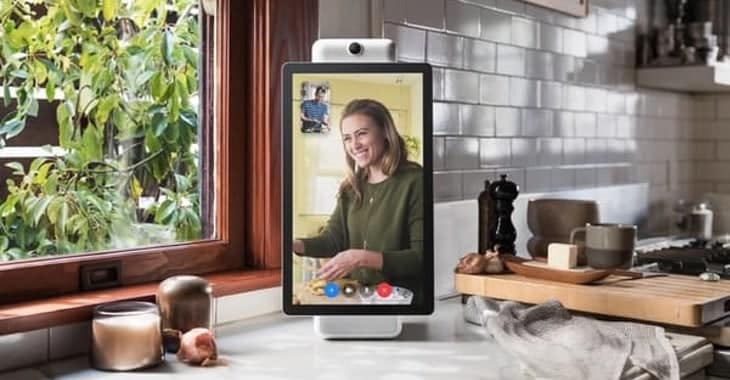
I don't have a Facebook account. I don't have a WhatsApp account, but our household now has a Facebook Portal.
And I have to say, pragmatically, it's a great way of keeping in contact with relatives and loved ones.
But of course, it comes from ruddy Facebook, which makes me extremely nervous.
So we do need something which sort of bloop, bloop, bloop up on the TV screen and announces that they're getting a call.
And what it does with the camera is very, very clever because it's tracking faces, and so it will focus on the relevant part of the room so it keeps you in shot, which is what we need with the in-laws, for instance.
The other version plugs into your television, and in all of them there is a hardware little what's-it, which will cover over the camera, should you want to, and you can turn off the audio.
And they claim that it doesn't upload any of your data and any of this to Facebook.
If you have relatives who you can't go and visit and you need to keep an eye on and you need to communicate with because you're worried about them.
So I've tried to lock it down as much as possible, but it is ultimately Mark Zuckerberg's camera looking at us.
So I ended up having to order it from Amazon in France, because at the moment, at least, we're part of the EU still.
One of those apps is Houseparty, which is somewhat different from Zoom, which many of us have used in a business environment.
And if anyone else from your collective is also part of that room at that time, they can see you and chat to you.
So you don't have to go through the effort of setting up, oh, at 7 PM, we're going to have a Zoom call. Here's the invite.
It's like a pub you can just drop in on without an appointment.
It's proven more attractive to some people who are understandably keen to keep in touch right now, maybe, but don't want to go the full caboodle of buying a Facebook Portal.
If I happened to log in and see that my mum was there, I'd go, "Hey, Mum, how's it going?" and connect immediately and start chatting.
I haven't actually played them, but yeah, I understand there's some simple games you can play together with everyone who happens to be online at the same time in the same room.
Well, in recent days, rumors have been spreading about Houseparty, and the rumor has it that Houseparty is unsafe and that it has suffered some kind of security breach or that it is doing something naughty.
If you go on Twitter or Facebook, you will see plenty of folks sharing warnings about the Houseparty app, claiming that after installing the app, they found that other online accounts were being compromised, like Spotify or their email account, or even in some cases, their bank account.
People are saying, I installed Houseparty, and then someone from Israel or wherever, logged into my Spotify account, and they've made the connection.
They've assumed that the two things are connected.
Maybe they don't normally install apps, but right now, millions of people are installing Houseparty, and then when something else suspicious happens, they're assuming it's Houseparty's fault.
But we also warn of apps that have dangerous components. So how are they supposed to tell the difference between— you're saying this is rumors, but without any proof.
So they're connecting the dots and thinking, it must be because of this new thing I did on my phone, rather than be the result of a phishing attack or password reuse or credential stuffing or somewhere where the hackers have grabbed passwords from a past data breach, maybe years before.
They assume it's connected to Houseparty.
And some of the advice which has been spread around, which is saying, delete Houseparty from your phone, if it had been the source of the breach, that doesn't actually fix the problem, does it?
Because your details have already been grabbed.
And just last week there were really widespread hoaxes about WhatsApp and people were warning about specific messages about the death of the Pope or whatever, which was a complete old-school hoax.
And for some reason, right now in the middle of this pandemic, these things start going around again.
As we suffer this zombie apocalypse or whatever is going on at the moment through this pandemic, there are other things you should be fearful of.
And people think they're being helpful passing these things on, but of course, there's no actual evidence.
In the warnings about Houseparty, there are no links to legitimate security researchers.
I would then go look for a news article from a reputable source to back it up.
Security researchers have looked at the Houseparty app and they say, I mean, any complicated app is gonna have bugs and vulnerabilities in it, but they say they've found no evidence that it is doing anything like this, which might cause the Spotify login attacks.
And again, Spotify is something which is used by millions. Many, many, many people, a vast number of people.
Now, Carole, you made this really interesting point. Was it Zoom who did it?
The owners of Houseparty are, and this is so weird, in some ways it's not weird, the owners of Houseparty are Epic Games. The makers of Fortnite and other popular video games.
They have not only said all Houseparty accounts are safe, we haven't had any kind of compromise, we don't collect passwords for other sites, but they've also offered a $1 million reward.
And what they want people to do is come up with evidence as to who has been spreading these hacking rumours, because they suspect it might be part of a commercial smear campaign to harm Houseparty.
Some people have been saying that Twitter bots have been posting messages about Houseparty being unsafe. Again, I think it's hard—
That's what they're looking for.
Can we record this on Houseparty? Or even better, can we record this inside Fortnite?
Protect yourself with two-factor authentication on any online accounts that support it.
So if your password is stolen or breached, it alone won't actually give the hackers access to your accounts.
And obviously follow standard best practices about not reusing your passwords.
Well, either kids or just people who just didn't understand what was going on and they joined the dots themselves and came to the wrong conclusion.
You just said that people are sitting in their homes and they might not be working as hard as usual, so they have time to come up with all these conspiracy theories or whatever.
I think that's actually an important point to discuss because the fact is the whole world is sitting in their homes right now and feeling scared and useless and addictively reloading news every 15 minutes, which is what we're all doing.
And I think it's just fair to say out loud to everybody that it's okay if you're not working as hard as you usually are. It's okay if you're not as productive as you'd like to be.
It's okay if you're not doing the projects you would be able to do now that you have all the time in the world. These are unusual times. This is a pandemic.
And when you look at it from a bit more perspective, this is going to be the biggest news item of the decade. This is going to be one of these defining moments of the century.
And this is like, what was the last time we had something which really affected the whole world at the very same time? I think it's the first time.
It didn't affect the whole world. This does affect every single country. Everybody, the whole world is in quarantine.
And this is so different as a quarantine from anything we've seen because we do have this online connectivity. And I think it's an important thing to consider for our audience.
I mean, security people, we spend our time trying to secure people and trying to help people who fight with problems they have no hope trying to figure out by themselves.
And while the whole world is sitting in their homes feeling useless because we are not medical experts, well, security people can sort of participate. We can try to help.
Of course, we can't find a cure and we can't help people in hospitals, but we can help secure these hospitals, we can fight off the attacks which are targeting medical organizations or targeting people trying to find the cure.
There are bad people out there right now. We've seen multiple attacks against medical organizations during this pandemic, which really, really sucks.
And yes, the more we can do to help fight off these problems, the better it is for everybody. And it makes us feel we can help, we can do something.
There's an organization called Cyber Volunteers 19, CV19, I will put a link into them in the show notes.
Friend of the show, Lisa Forte, she's one of the forces behind Cyber Volunteers 19. So people may want to go there and find out how they can offer their expertise.
So, you know, don't feel too helpless. But I agree with you, Mikko. I think we all need to give ourselves a bit of a break as well and not stress out too much.
There's enough stress in the world right now that if we're staying at home, you know, don't feel that everything has to be perfect.
I mean, I was just speaking to a friend of mine who said that he thought he would read through all these great books, and he confessed that he didn't even open the first one yet.
It's just hard to concentrate. It's hard to get anything done.
They've been accused of really dodgy privacy policies and about sending information to Facebook and all kinds of things which really emphasize the point that when you have a product like this, which is growing faster than pretty much any product ever in the recent history, they might cut some corners.
And in this case, the corners might be privacy corners.
One of my favorite podcasts outside of Smashing Security.
And they had an hour-long show about the history of Zoom, where it came and who are the guys behind it, who are the girls behind it and how exactly they did the IPO.
Really interesting stuff worth listening.
But when we think about the idea that there's these new products which become so successful despite privacy problems, Zoom is not the only example.
We can think about things like Huawei, the Chinese manufacturer.
Their phones, I just checked this, their phones are in top 10 most common, most sold handsets in dozens of countries around the world, despite the fact that they've had all these reputation problems regarding privacy and nation-state access to their devices or to their gateways.
Zoom has this problem. Telegram, WhatsApp has been accused of lousy encryption, at least by default. It doesn't slow them down at all.
So as long as the product is good, and obviously Zoom is a good product, Telegram is a good product. Clearly Huawei phones are good phones because people buy them.
TikTok is growing like crazy because it's, you know, apparently it's a good product. But so—
If it's free and it's a good product, they will use it regardless of the problems behind it.
I mean, if it's free and it's a good product, it could do pretty much anything behind the scenes and people just don't care. And we saw this very, very well ourselves.
At F-Secure, we were in the middle of releasing a cloud storage product 5 years ago when the Snowden leaks came out.
We did a pretty extensive study in different European countries asking consumers, and you know, in the middle of all these Snowden revelations, would you be interested in a European cloud provider instead of these American cloud providers where you would be guaranteed that your information is within EU or even within your own country?
And the result was an overwhelming yes. Everybody, of course, said yes, that I would absolutely prefer a local European provider.
Then when we actually released the product, nobody cared.
Everybody went with the free product from, you know, the thing which was built into the device or built into the operations. And of course, those are all from USA.
So there's one thing that people say and another thing that people do.
Niche, or niche for our American audience. You know, how do you do that?
I mean, I know, you know, but you know, if my mom was told, hey, go use this particular app, she would just trust because the person who told her, she trusted them.
But she would also feel flustered that she was told two different sets of information. And I get that. I get that.
And I think there's another few states that are fast on the heels as well. But I think also caring for these things is a luxury as well.
Especially right now during a pandemic, people are thinking, oh my gosh, I need to stay in touch with my family.
And people, they hear from someone, oh, use this app, Houseparty, or use Zoom.
And so everyone just jumps on the bandwagon, and no one really looked to see what exactly the privacy things were.
You mentioned that, Graham, in your story.
And this is probably giving them a bit of edge over the competition, you know, the ones that are coming to the table late.
Now, I guess it's not a surprise that we're seeing remote working tools and a number of users.
So we're seeing more people use cloud shares and client firewalls and VPNs and video conferencing tools like Skype and Zoom. Zoom, we've talked about.
And I've always hated video conferencing. I don't know about you guys. Do you feel it connects you better with the people that you're conferencing with?
Because I'll tell you, I remember every time I video conference, to me, there's this one American lady that I worked with. Graham, you worked with her too. I'm gonna call her Dolly.
And she was sitting really close to her camera chewing on this apple and the camera kept going to her face. It was just a horrific scene. And I just don't know why people need video.
Maybe that's why I do radio. So maybe I'm more into audio than—
I mean, in the current situation, as we've been saying, in the current situation, I think there are some pluses, uses which can be got from it.
But generally, I would agree with you that it's actually a bit of a distraction. It gets in the way of the communication.
But for some people, all these remote tools that make life easier are not enough because some, Mikko, are worried that their employees are going to slack off.
And the bosses are very concerned about maintaining or at least protecting the company's productivity.
So I started looking around and there's a veritable huge world of online productivity services out there. So I compiled a selection for you guys to look at.
And I wanted you just to take your take on them because they're all a little bit different and the way they market is fascinating. So number one, I started easy, right?
So number one on the list here is Active Track. So if you check the link in the show notes.
So it's very transparent and making sure it's not intrusive and it's also following the legal legislations in your geography.
They didn't want to tell them whether the CEO was under the same treatment. Sneak is pretty interesting, right?
Because who wants their teammates' pretty faces all on one screen whilst you're working? I mean, where do you actually work?
And if you look at the difference between the two options, there's a stealth mode available.
And sometimes you get people to change their minds. Graham now has Facebook Portal. Who would have ever guessed that he would have done that? Please don't talk about that.
They're not going to be terribly happy and they'll try and subvert it in some fashion with a cardboard cutout or whatever.
So you can see work in progress as it happens by taking screen captures customized to each user.
So one party has to know that they're recording versus both parties.
And I believe that's what is the case in the UK, although things change slightly because you're using a computer provided by your company.
Now, this is where it gets tricky for us all because these computers now are effectively 24/7 in our personal homes.
So if you're taking video snapshots of the user, and their screen, you're capturing information that has nothing to do with work. And where is that information being stored?
So for example, if you were in a smaller house, which many people are trapped in, and you have to work from home and you have your kids running around, pictures of your kids and your family can be easily snapped in the background.
You have a boss that doesn't spy or monitor, and I think all of us would say, yeah, that's obviously a better way because if you don't trust your employees, that does, you know, morality kind of goes top down.
So I think it's important to ask because I'm not sure how not telling the truth in that situation would work for your employees.
So getting it in writing that they are not monitoring you might be a good idea if you're concerned.
I mean, at the moment when so many people are being laid off, unemployment's on the rise, a lot of people will be very nervous, won't they, of doing this.
I imagine more and more people will be, they won't it, but they may think they have no option but to accept it.
Which has been downloaded as a zip.
Now they've got something that I think you're going to, a capture the flag competition, which can win you a $100 Amazon gift card.
If you want to join in all the fun, visit domaintools.com/smashing to enter the competition before it closes on the 16th of April. And may the most geeky listener win.
So many of us now are realizing that moving to a fully work-from-home environment isn't always easy, but LastPass is here to make that transition easier, all without decreasing security.
LastPass ensures your employees have secure access to their work applications and provides remote employees the ability to securely share passwords across teams in order to stay on top of critical projects.
If you want to learn more visit lastpass.com/smashing. On with the show.
Could be a funny story, a book that they've read, a TV show, a movie, a record, a podcast, a website, or an app. Whatever they wish. Doesn't have to be security-related necessarily.
Instead, it is a podcast which has nothing to do with security, or indeed, I'm afraid it isn't in the Finnish language either. It is a podcast called Something Rhymes with Purple.
And Something Rhymes with Purple is a lovely little podcast hosted by Giles Brandreth, who is a former British MP and TV celebrity and famous jumper wearer, and Ms.
Susie Dent, who has appeared in Dictionary Corner of Channel 4 TV's Countdown show since 1992.
And what they do on this podcast basically is they talk about unusual words, or sometimes not so unusual words, and they talk about the origins of these words.
So, for instance, by the way, you can also follow Susie Dent on Twitter where she will have a word of the day quite often. For instance, she just tweeted about the word freelancer.
Timely.
And she explained that freelancers— get this, get this, right— freelancers were originally knights who weren't attached to any single lord or master, and so were free to use their lances, weapons, to anyone who paid them.
And that's why we have freelancers.
If you ever wanted to know what namby-pamby, where that comes from, or grockles, or why Alexander Graham Bell recommended that people answer the telephone with ahoy rather than hello, then Something Rhymes with Purple is the podcast for you.
And that is why it's my Pick of the Week.
My pick of the week is a song, or even better, it's a video of a song.
This is a song composed by a Finnish composer called Jussi Chydenius, who actually is a pretty well-known a cappella singer in Finland.
The lyrics were written by Julia Junttila, and this was made for the Väski-Vuori Upper Secondary School Chamber chorus.
And they've actually recorded the particular song that we are linking to in their homes during the pandemic.
So this is all being recorded with like teenagers on their phones or from Zoom or from Skype. And when you combine it together, you end up with something amazing.
Just listen to this.
The basic idea is that the teacher did a basic skeleton of the song as an MP3, sent that to every kid, and then they were listening to it and singing their part on top of it.
And then they would have put in quite a bit of effort to cut it all together. But the end result is worth listening to.
Because it turns out this guy called PippinFTS, that's his handle, claims to have made a 1-to-1 Minecraft version of Earth for the very first time.
So that is actually, in normal Minecraft, that's kind of impossible because there's a height limit in Minecraft, which is limited at something like 250 metres or something.
So it makes—
But this PippinFTS guy claims to have used cubic chunks, which somehow helped him change the shape of the Minecraft chunks to 16 by 16 by 16, which gives you infinite depth to build in all directions.
So I've put a video—
So things like you'd expect to see Egypt's pyramids if you went looking for them, but actually at the moment they're just big piles of mud.
So apparently, this PippinFTS guy has gone out to start a collective project called Build the Earth to get other Minecraft players to decorate the Earth with well-known manmade structures.
He could get— Has anyone actually checked whether the pyramids are still there? Because with everybody locked down, maybe they're not. Maybe it's like Schrödinger's cat.
Although I have to say, I would do it maybe with sound on low, so it's a very, very inspirational kind of opening conversation.
So take a look, see what you think. All the links are in the show notes for you.
So the real question is, when are we going to get a model of Earth in LEGO in scale?
Well, that just about wraps up the show for this week. Mikko, thank you so much for joining us. I'm sure lots of our listeners would love to follow you online.
What's the best way for folks to do that?
So if you're on Reddit, go and look for Smashing Security up there.
Also, a huge thank you to this week's Smashing Security sponsors, LastPass and Domain Tools. Their continued support helps us give you this show for free.
Check out smashingsecurity.com for past episodes, sponsorship details, and information on how to get in touch with us.
Hosts:
Graham Cluley:
 @grahamcluley.com
 @
@
 / grahamcluley
Carole Theriault:

Guest:
Mikko Hyppönen – @mikko
Show notes:
- Herrasmieshakkerit — Mikko’s security podcast (in Finnish) with Tomi Tuominen.
- Video trailer for Herrasmieshakkerit — YouTube.
- Has Houseparty really been hacked? $1 million reward offered to unearth who is behind widespread claims — Graham Cluley.
- Houseparty declares that all accounts are safe — Twitter.
- Houseparty announces $1,000,000 bounty — Twitter.
- Zoom Meetings Do Not Support End-to-End Encryption — The Intercept.
- The most popular smartphones in 2019 — DeviceAtlas.
- The Zoom IPO (with Santi Subotovsky) — Acquired podcast.
- Cyber Volunteers – Protecting and Responding for our healthcare services! — CV19.
- Bosses Panic-Buy Spy Software to Keep Tabs on Remote Workers — Bloomberg.
- Your Bosses Are Trying To Spy On You Now More Than Ever — Futurism.
- Companies are using webcams to monitor employees working from home — Business Insider.
- Something Rhymes with Purple — Acast.
- Susie Dent on Twitter.
- Virtual choir from Finland: "Song of the Fearless" — YouTube.
- Someone's built the entire Earth in Minecraft – to scale — Eurogamer.
- The Earth in Minecraft, 1:1 scale …for the first time — YouTube.
- Smashing Security merchandise (t-shirts, mugs, stickers and stuff)
- Support us on Patreon!
LastPass Enterprise makes password security effortless for your organization.
LastPass Enterprise simplifies password management for companies of every size, with the right tools to secure your business with centralized control of employee passwords and apps.
But, LastPass isn’t just for enterprises, it’s an equally great solution for business teams, families and single users.
Go to lastpass.com/smashing to see why LastPass is the trusted enterprise password manager of over 33 thousand businesses.
DomainTools helps security analysts turn threat data into threat intelligence. Its solutions give organizations the ability to use and create a forensic map of criminal activity, assess threats and prevent future attacks.
Learn more about their products at domaintools.com, or visit domaintools.com/smashing to enter their Capture The Flag competition and be in with a chance to win a $100 gift card.
Follow the show:
Follow the show on Bluesky at @smashingsecurity.com, on the Smashing Security subreddit, or visit our website for more episodes.
Remember: Subscribe on Apple Podcasts, Spotify, or your favourite podcast app, to catch all of the episodes as they go live. Thanks for listening!
Warning: This podcast may contain nuts, adult themes, and rude language.