


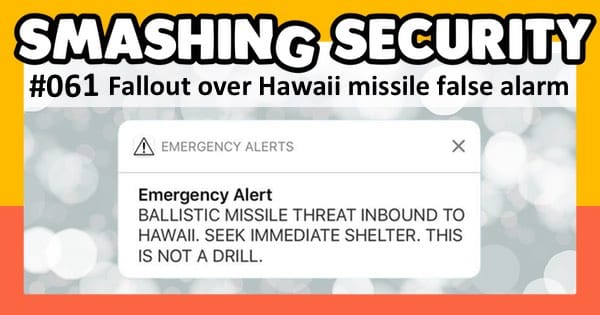
User interfaces and poor procedures lead to pandemonium in Hawaii, hackers are attempting to trick victims into opening cryptocurrency-related email attachments, and yet more pox-ridden apps are found in Android’s Google Play store.
All this and much much more is discussed in latest edition of the “Smashing Security” podcast by cybersecurity veterans Graham Cluley and Carole Theriault, joined this week by Paul Ducklin.
Show notes:
Please check out the show notes for this episode of the podcast on the Smashing Security webpage.
Show full transcript ▼
 This transcript was generated automatically, probably contains mistakes, and has not been manually verified.
My name is Graham Cluley.
Sorry, I better deal with this.
With CloudBerry, you can back up files, folders, and system images to the cloud storage of your choice with built-in 256-bit encryption. Ensuring your precious data remains private.
CloudBerry supports over 30 cloud storage providers, working on Windows, Macs, and Linux. Plus, no subscription—you pay only once. So download a free trial at cloudberrylab.com.
But there's more—you could also go to smashingsecurity.com/cloudberrylab to get a whopping 30% off the Windows desktop version that goes for about $20. Boom!
This episode of Smashing Security is sponsored by LastPass. LastPass sophos.com/lastpass.
Sophos simplifies password management for companies of every size, but it isn't just for enterprises. It's equally a great solution for business teams, families, and single users.
Learn more at smashingsecurity.com/lastpass. On with the show.
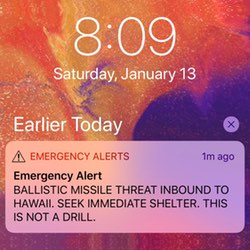
Well, last Saturday in Hawaii, just after 8 o'clock in the morning local time, people were woken up by a message bleeping on their phones saying ballistic missile threat inbound to Hawaii.
Seek immediate shelter, this is not a drill. And similar warnings, of course, automatically appeared on TV screens and on radio stations.
Now, I don't know about you chaps, but if you saw a message that, and of course if you were in Hawaii, what would your reaction be?
But maybe in Hawaii you're brought up to learn about these missiles and the missile threat. Maybe it's something to do with their location or something.
Yes, but certainly in the 1980s, you know, there would be little public information films on the television and there were warnings about what to do.
You got leaflets through the door as to, you know, really? Yes, yes, absolutely.
About hiding under the stairs and painting yourself with white paint and things to reflect the nuclear blast.
And just last month in Hawaii, they started retesting their nuclear warning sirens for the first time since the Cold War.
You've got to remember, Hawaii is a target not only because it's a huge military base, but also, of course, it's quite close to countries who may not be entirely friendly.
To America.
And of course, it's not just that they've started retesting their nuclear warning sirens.
We've also seen the United States and North Korean leaders have, you know, trading insults with each other about the bigness of their nuclear buttons. And well, which is—
If we imagine getting a message like that on our mobile phones, our reaction is to be cynical and laugh or think, oh, someone's hacked the system or something like that, because the other possibility is almost too horrific, isn't it, to contemplate?
I guess we're all used to scams and phishing and spam and all the sorts of nonsense you get even when you ask not to receive it, that you're just awash in garbage SMS that— what a strange vehicle unusual, it seems to me, to use to tell someone that there's a nuclear bomb coming.
On the other hand, if there is one coming, you don't have very long. You do want to use the fastest, most efficient medium, don't you?
And they do this in other American states as well. If there's a terror alert and they can basically blast a message to everybody's mobile phone.
Right, yeah. The idea is you can get a message quickly to everyone who happens to be in that region.
So it's not done by subscription, it's done by where you are, which is obviously more important than if you happen to be visiting Liverpool.
We've got a recording actually of the message which went out on radio stations, which was constantly repeating.
You kind of think, oh, that's sort of funny, but it's not funny because you could seriously hurt yourself.
Thankfully, there don't appear to have been any casualties from people panicking around and hiding in places, but there've been some really harrowing stories online as well.
There's an article in The Atlantic, stories of people putting their kids in the bath and just praying with them. And the kids are in tears and the parents are in tears.
My understanding is they do them from when you're tiny and you just know what to do when there's an earthquake.
And so it's like, well, where do you go, you know, when something like this happens? Some people didn't panic at all.
I saw some videos online of people who were sort of halfway through their round of golf when they got the message and they sort of left a message for loved ones saying, well, I'm gonna— if I'm going to die, I'm going to— I'm just hitting the 17th hole.
And what happened was a member of staff at the Hawaiian Emergency Management Agency started their shift, and one of their jobs on this particular shift was to initiate an internal test of the warning system.
And they opened the menu, they dragged their mouse down the menu options, and there was one option which said "Test Missile Alert" and another one which said "Missile Alert." And guess which one they clicked on?
And it was as simple as that. Someone pressed the wrong button and sent the message. It's not really as simple as that, is it?
And maybe they're just in the habit of going, yeah, yeah, you know, do this all the time. Who knows? Maybe they were just a bit sleepy starting their shift. Who can say? Right.
And when you look, you'd see that you didn't get a test, you got the real thing. You'd know that something had gone wrong.
And then presumably you have procedure B, which is the alert just kidding! We failed the— well, they did a test, and to be honest, the test failed. Yes, yes.
And they didn't notice the test had failed. And to me, that's more of a problem than maybe there was a GUI that was too easy.
The problem was that the Hawaiian Emergency Management Agency aren't authorized to send out corrections.
They can tell you that a missile is on its way, but they can't tell you that a missile isn't on its way.
They can't send a follow-up saying, "Whoops, ignore that last alert." They're not allowed to until the wording of the correction has been authorized by another agency.
So they get a marketing team in to huddle, you know, "What's the spin we're going to put on this?" "Well, don't you think we should get this message out quickly?" "Yes, but we have to word it properly." "Your security is important." Graham, we have faced that exact scenario in our work life in situations.
So I'm sure they did try and organize it quickly, but of course they were caught off guard. But, you know, as you can see, this wasn't purely a user interface issue.
This was a procedural issue. They hadn't thought about what would we do if we sent out a wrong alert.
So what they've done to fix this, because humans do make mistakes and humans will make mistakes in the future, they've put systems in place now so that they can speedily put out a whoopsie.
You know, didn't mean that one. Sorry. Well, that's good. Great. So they can do that now without getting authorization if they goof.
Additionally, a second person has to approve the sending of the genuine alert now.
I don't know if a second person is also required for the test alert or what, but at least a second pair of eyes just to make sure that that's the right thing to do.
But I think, you know, we shouldn't beat up whoever was responsible for this too much because, you know, people make mistakes and it was an easy mistake to make and we should use technology to reduce the chance of this.
Yeah.
That they may be less likely to believe an alert next time or just wait a little bit to see if something else comes through as well.
It's not good news, but I suppose the good news is there wasn't a missile. Exactly. So from that point of view, a success, I guess. A yay moment. Hooray!
So, Duck, what have you got for us this week?
Ever-increasing number of phishing emails relating to cryptocurrency, hanging on words like blockchain.
And typically in the past few months, whenever crypto mining, cryptocurrency, blockchain, bitcoins, Monero, any of that stuff has come up in the context of cybercrime, it's either been 'Oh, somebody hacked such and such a cryptocurrency exchange and ran off with a load of currency,' or 'Somebody broke into your computer and put software there to use your electricity to mine coins.' It was always the end rather than the means of the cybercrime.
And in this case, because of the popularity in the news, given the rapid increase in value of things like bitcoin or Monero, the malware in this case had absolutely nothing to do with crypto mining at all.
They're saying to you something about cryptocurrency to make you click on an attachment or click on a link?
The interest in this story to me was there was a— neither of these things is new on its own, but it was the first time I'd seen two at the same time.
Unusually, in this particular campaign, the attachments were .iso files, so disk images, which people would normally associate with Linux distros or a Windows installer download or a ripped CD.
Yeah, and of course, as we know, Windows— and it's not the only operating system, but I'm just pointing my finger at Windows here— Windows really thinks that you don't need to know that a file is called blah blah blah.iso, even though it uses the .iso extension to guide its own handling of the file.
It's not important to you, don't bother your little head with it. So by default, they suppress extensions. So you think you're opening a PDF.
You're actually opening an ISO file, which unfortunately most people sort of associate with, even if they know what it is, with not much to do with malware.
So unlike a zip file where it opens up and it looks like a file that you saved to disk and opened, when you double-click an ISO attachment on Windows, it opens up as if it were a drive.
So you get a drive letter, right? So it kind of— that visually it's very different from what you'd expect if you download a file and it's on your desktop and you open it.
It looks different in File Explorer.
I would imagine that we've seen so much malware now being distributed by zip that some people are more suspicious of zip files. It's old hat. Exactly.
Suddenly suspicious of .exe files.
I would imagine many companies created their own rules and their own filters, and they said, look, we're going to allow certain file types in, but a zip maybe will go through some more thorough testing, if not blocked entirely.
But ISO, I suspect many people haven't even thought about.
I wrote about it on Naked Security and a commenter came back and actually said, you know what, well, of course we block ISO files. Who'd want an ISO in email? It's kind of pointless.
You can just go and download it. But I had to go and check because I couldn't put my hand on my heart and remember, it was so long ago.
It was a bridge we'd never thought to cross or revisit. And I had to go back and verify that I really had put this in as a rule years and years ago.
It's the kind of thing you don't really think about. Now, crooks have been using ISO attachments for ages, but it's always pretty much been under the radar.
For instance, I mean, executable code-wise, it's things like Windows font files or Windows help files can contain malicious code and things which probably the average chap in the street would never consider could potentially infect their computer.
But there are lots of other ways in which you can package things. You're on Macs, you've got DMGs, which are disk images.
And if you go to something like HDIUtil, the hard disk imaging image utility on a Mac, I never realized just how many different variants of ISO type files that there are that are natively supported by many operating systems.
So you see this file and you don't realize that when you open it, you're basically mounting a new disk and it can have any number of things inside it, including more zip files that can have more doc files and so on.
But of course, a lot of us these days in our job like if you work in HR or something and you're dealing with CVs, your job is kind of opening unsolicited documents half of the time because somebody's applying for a job.
You don't know who they are. You want to open the file and see what it is. So it's very difficult just to say don't open attachments.
The big deal in this is that, yeah, cryptocurrency and blockchain. Wow. Got to read that. Don't be fooled.
But I think the big advice is if you have Windows, open File Explorer now, click on the View menu and say Show File Extensions. Yeah, change the default.
Don't let Windows lie to you about the full name of a file, because as we know, when the crooks put a double extension in there, like .pdf.iso or .pdf.zip, you— particularly if they give the file an icon that looks like a PDF— even a well-informed user with the default setting of not showing extensions would have to be forgiven for assuming that what they were looking at was the real deal.
Good advice. And Microsoft, please change the default.
And we also know malicious developers are constantly working to try and beat those security filters. Hang on, Google doesn't have malware anymore, does it?
But these apps weren't what they purported to be. Instead of being cute little gaming apps to keep your kids entertained, they were full of nasty surprises.
So say hello to what Check Point have aptly named the Adult Swine App Collection. Adult Swine. Yep, Adult Swine malicious app collection. So this is how it works.
After a user installs one of these 60 gaming apps, the first step is report home to the command and control center about the successful installation and also to send data about the infected device and the user.
Then it waits to receive instructions on how to operate. Now, according to Check Point, these malicious gaming apps had 3 potential attack vectors. All right.
Now, one was to display highly inappropriate content, including porn. So you'll see, I've sent you guys a pic of one of the more mild examples of the ads presented.
And there's also a comment from one of the victims. So this is someone that actually downloaded the app. And he says, don't install for your kids.
I did, and my son opened it and a bunch of filthy hardcore porn pictures popped up. Not good at all. My son is only 4. So please, parents, beware, don't install it. One star.
Can you not give no stars? One star. Oh, it was okay.
But of course, very inappropriate ads for the demographic that these games are going after or purporting to go after. Now, that's just one of the things it can do.
The second thing it can do is it can attempt to trick users into installing fake security apps.
So this is what we call scareware, where messages are displayed maybe with a Google banner and a Google layout and Google fonts to tell you that a virus has been detected on your device.
And then it recommends that you buy and install this particular security app, which of course is not a security app, but another fake app designed to steal something from you.
And 3, it could try also to dupe the user into paying for premium services.
And the way that the apps do this is to display an ad that claims that the user's entitled to win a new iPhone by simply answering 4 short questions. Yeah.
But you know, this really—
But of course, that phone number was used to register the user for fraudulent premium services, all at, of course, the victim's expense. Now here's what I consider the boom moment.
You know, this app wasn't just downloaded by a few hundred or a few thousand people. According to Google's Play data, the app's been downloaded between 3 and 7 million times. Whoa.
So in other words, that's like everyone in Trump's beloved Norway downloading the app or everyone in definitely not a shithole El Salvador downloading it.
You know, you have the free app and it has ads, and then you pay a modest fee and the ads go away, and people sort of deal with that.
And Google have tried to say, oh, well, you can't have full-screen ads, they can't be too intrusive, and they can't be too loud and whatnot.
So people are kind of used to the idea of ads. That's the A. So they're kind of an accepted part of the ecosystem, if you like.
But B, my understanding is that a lot of apps where the developers probably aren't rogues are, they're saying, well, I need to addify my app.
So you go out and instead of knitting your own ad serving code, you just go out and choose a library that has the code, sort of like coin mining.
You go and you pick the library and you pick the server and you sign up for the service. And so your app looks okay, maybe passes all of Google's entirely automated tests.
So it looks okay because, oh, it's using this ad framework and ad frameworks are big and they serve lots of different constituents.
Even if that ad backend is not a bunch of rogues, you're assuming they're completely competent and they won't mix up 4-year-old children with 22-year-old males.
We want to display some adult ads in the middle of here. It's not as though that's going to drive a large number of people to those adult websites.
They're certainly not going to sign up for those websites, are they? Because—
And their developer, their developer certificate or their developer ID is the one that's going to get in trouble, not the library that they've chosen.
Well, this is the point I'm going to come to, Carole, is that I think we need to find a better way to monetize apps than advertising.
But of course, people aren't prepared to pay $1 or $2, which is the cost of— I don't know, probably less than a coffee costs. I have no idea because you don't drink coffee.
I don't, but to buy an app. So here's one idea, right? Because I would love it if we had an ad-free app universe, right? If there was some other way to do it.
I accept that people won't necessarily be prepared to buy an app blind.
So I'd like to see some ability from these app stores to let you trial an app for a while, first of all, decide if you like it, and then you can buy it after 30 days or something if you want to carry on using it.
But another method which may be could be used would be, why can't an app store say, look, you can have access to thousands and thousands of apps.
And what we're going to do is we're going to charge you $1 a month or something like that. Netflix model. Yep.
And then the app stores could actually divvy that up with micropayments to the app developers whose apps are actually being downloaded and say, look, this is the way you're going to make your money.
We'll get a chunk of it. Don't worry, Apple. They'll still get their chunk, and Google will get their chunk as well. But some of it will be passed on to the app developers.
That, I think, would improve the quality of the apps and mean that they're not festooned with these irritating, sometimes malicious ads as well. You heard it here first, Google.
A lot of the problem with Android is people say, oh, it's because it's the price of freedom. You know, you can choose to go off market and you could get your app somewhere else.
But this is stuff that's in Google Play. Yeah. That's had millions of downloads, presumably because the app's okay, but it's got into bed.
It's got in partnership with this live programming library that's built in that's serving Roe, basically malvertising, if you like. Yes. Of a different sort.
How come, how come this problem is so much worse, seems to be so much worse on Google Play than it is in the App Store?
They make a big play about, oh, there's no more— we're not calling it malware, they're just potentially harmful applications.
We do this great job, you don't need an antivirus, you're all golden, we'll look out for you.
And there may well be guidelines regarding how adverts are presented. There may even be guidelines, I don't know, regarding approved ad networks.
I don't know if you have to sort of get into bed with Apple regarding that, but there certainly will be a lot more control, I would imagine, as to how ads are actually displayed on the screen, much, much more than there would be on Android.
But here's my big beef. I haven't seen a "sorry, we screwed up" from Google, and you know what, they should. And if they have, they haven't done it loud enough.
After all, Google indeed have the reach to disseminate information pretty broadly, right? So I don't know.
I mean, put it this way: if a supermarket like Tesco sold kids lollipops riddled with maggots, would the store remove them from the shelf and say "hey, thanks for the heads up" or "we'll be more careful"?
Or would they be forced to do a very public mea culpa?
From what I read, a little bit more vetting goes in to ensure that the apps follow the rules for that audience.
And the other thing is that these 60 games, they generally had a kind of—they were knockoff games.
So, and I hate saying this for the reason you mentioned earlier, Graham, is how do you support new legit app developers that come out that have something important to share?
But maybe stick to apps that are from well-known and trusted suppliers.
Because there was that famous case recently where somebody had uploaded an app that didn't pretend to be WhatsApp, but it pretended to be WhatsApp, you know, like from WhatsApp that would help you with WhatsApp.
And the reason it got through and looked legit is they put a, I think, a non-breaking space character at the end of "WhatsApp, Inc." as the company name, non-breaking space something like that.
Google let it through because it wasn't an exact match, so they figured, okay, that's obviously—it's not WhatsApp, and nobody would possibly be confused, which of course they were.
But it seems an irony that they've got this curated part, but it does seem that the curation is kind of wanting.
They've built the world's best search engine, they've got driverless cars, they're hoovering up our Wi-Fi credentials, they're taking photos of us left, right, and centre.
No doubt they're also planning a manned mission to Mars or something like that.
And yet they can't handle a non-breaking space character in an app name without thinking, oh, what's the world coming to?
LastPass Enterprise simplifies password management for companies of every size with the right tools to secure your business with centralized control of employee passwords and applications.
But LastPass isn't just for enterprises—it's an equally great solution for business teams, families, and single users.
Go to smashingsecurity.com/lastpass to see why LastPass is the trusted enterprise password manager of over 33,000 businesses. Remember Cloudberry?
With them, you can back up files, folders, and system images to the cloud storage of your choice.
There's no subscription, plus you get 30% off the Windows desktop version if you go to smashingsecurity.com/cloudberry. On with the show.
I forgot. So a chap, I imagine it's a chap called Ruan Yifeng, who I believe is Chinese, posted an image on Twitter. Now I want you to imagine this, right?
Because it's hard to describe a picture on a podcast.
You know when you book a seat on an aeroplane, you get quite often a diagram of where everyone's seat is and these ones are near the loos and this is near the galley and this is the aisle and you can choose where you sit and there's little drawing, you know, icons of people and all the rest of it.
Well, it's a bit like that, but it's not an aeroplane which is being conveyed here.
Instead, what he has a picture of is a visual display showing the occupancy, not of airline seats, but of lavatories. I've got to see this.
So, this is an image, I imagine it's at a supermarket or some large office block or something like that, and there are lots and lots of cubicles and at the moment, 1, 2, 3, 4, 5, 6 of them.
But maybe you're trying to evacuate from yourself something which you don't want other people to overhear, or maybe you're concerned about the environmental impact.
And so you want to choose a lavatory—
Then it could be someone behind you and that could also be awkward, right? So this way you can make sure there's absolutely—
So we've got a new car park here in Oxford, the Westgate Centre, which is— we can talk about that for a long time, my issues with the Westgate Centre.
But the new car park has a little green light over the empty car parking spaces and a red light.
Well, I've often thought that there should be some sort of traffic light system working on lavatories. I've thought, wouldn't it be terrific?
Because the other problem is not just whether a lavatory has been vacated, but the state in which it has been vacated.
But simply hitting something as you left would maybe start a timer, which would then denote this cubicle hasn't been used maybe for a minute, right?
Which may have been enough for anything that you've left behind in the atmosphere to dissipate, whereas you don't want something which is still sort of fairly bright pinkish, for instance.
You think, oh, I'd like to go. I want to go to the gents, or in this case, the ladies. And so you're going to which one has got plenty of empty cubicles.
So when I get there, I won't be fighting with someone for the last one. What I want to see is because I'm clever enough to see the little red or green thing on the door.
What I want to see in there is a little blob next to the person that says whether there's paper left.
Because there's nothing worse than going in, sitting down, and realizing that you're on your own.
You see, this is because you can shout to the guy next door, anyone got spare rolls?
I noticed that cubicle C13 is larger than the others, so that's kind of handy if you've got a lot of shopping with you or if you've got young kids. And there's the mysterious C25.
I'm not sure, but I wonder whether we will see something like this occurring and whether, you know, in other lavatories around the world.
Maybe listeners can keep in touch with us and tell us the developments on the lavatories.
What worries me most about this diagram is it goes up to, what is it, C45, and if you ignore the accessible toilet where the entrance is from the outside, which has its own base.
Listen, there are 40, more than 40 cubicles. There are 40 carsies and 4 sinks.
And I wanted to know, you know, you mentioned the plane thing, Graham, can you, you know, when you, if you're outside, can you play a joke?
Can you click on the person who's in C22 and move them to another cubicle and they just teleport?
What we don't know, because none of us can reach— Maybe you can reserve a cubicle.
Some people are— Someone's reserved it, and for 2 minutes you can go in and it's yours, and your phone unlocks the door and you go in, and so you're guaranteed that so you don't get disappointment.
And so if you knew that, oh, after lunch, 2 PM, chances are I'm likely to want to go to the lavatory, and you could book it. That's a fantastic idea. I like it.
My pick of the week, or how I'm supposed to say it in a funny voice but I can't bring myself to it, is apparently some law enforcement guys, some cops in Taiwan had a kind of cybercrime quiz and they gave out prizes, USB keys, and unfortunately they had malware on them.
Oh boy. Oh dear. Facepalm moment. Yeah. Yeah.
Plugged in the key and found out that you weren't immune to the malware that they just handed you and had to ask them the difficult question, "How many other Windows laptops has this been in before it reached me?" And you just think, wow, some things we never learn.
You know, when you stick a USB key in a device, it can, generally speaking, can get written to as well as read.
And if you want to validate one or verify it, to be secure and safe and correct before you hand it out, you've got to use a special system that does not auto-mount it and doesn't write things onto it.
And you'd kind of hope that law enforcement, who are in chain of custody and preserving evidence, you'd have thought that that was the last place where that would have happened.
So every time I see it, I think, yeah, yeah, be very careful. And I then, I ended up sometime later at Black Hat in Vegas, and I was a bit late on the evening to the PONY Awards.
And as I walked in, the hall's full, and they were just announcing that IBM was up for a PONY Award. I can't remember whether they won. For that very blunder.
And I was able to— they didn't have a sample, and I was able to haul this one out of my bag, and it went on display for the Pony Awards.
So, and I think, was it Aldi once were selling pre-infected computers? Olympus had pre-infected cameras. Yeah, yeah, yeah. Wow.
It's if you're going to give somebody something that represents you, it's a very bad idea to have malware on it. Yep. Yep. Yep. Yep.
The irony makes it double worse in this case, but it's bad for anybody. Crow, what's your pick of the week?
It has this cool new feature where apparently you take a selfie and it trawls its data bank of paintings to find the closest match.
So I would love to hear from some of our US listeners about their thoughts on this app, because I obviously— I downloaded the app yesterday.
I read about this feature, I downloaded the app, and then I couldn't find—
Now, even without this feature, this little game that people are playing, the app itself is actually kind of cool. It's full of little gems.
You can learn more about arts and culture through online exhibits.
There's cool kind of virtual museum explorations, virtual tours of historical sites, histories of influential artists, etc. So I actually think it's quite a cute little app.
Twitter wouldn't allow us to have the G.
You can join us on Facebook at smashingsecurity.com/facebook where we have a Facebook group, or go and check out the store where you can buy all kinds of goodies at smashingsecurity.com/store.
Thank you, Duck, for joining us. If people want to follow you online, where's the best place to do that?
So thanks to everyone who's done that already. And you can check out our past episodes on our website, smashingsecurity.com as well. Until next time, cheerio, bye-bye.
Hosts:
Graham Cluley:
 @grahamcluley.com
 @
@
 / grahamcluley
Carole Theriault:

Guest:
Paul Ducklin – @duckblog
LastPass Enterprise makes password security effortless for your organization.
LastPass Enterprise simplifies password management for companies of every size, with the right tools to secure your business with centralized control of employee passwords and apps.
But, LastPass isn’t just for enterprises, it’s an equally great solution for business teams, families and single users.
Go to smashingsecurity.com/lastpass to see why LastPass is the trusted enterprise password manager of over 33 thousand businesses
Backup files, folders and system images to the cloud storage of your choice – with built-in 256 bit encryption ensuring your precious data remains private.
CloudBerry supports over 30 cloud storage providers, and works on Windows, Mac, Linux.
And unlike many of the other online backup solutions out there, you pay only once – rather than a subscription.
Find out more at cloudberrylab.com, where you can download a free trial and also explore CloudBerry’s solutions for businesses and MSPs.
Go to smashingsecurity.com/cloudberrylab to get 30% off the Windows desktop version. Meaning you can get this great software for the super price of around 20 bucks. Offer expires February 10th 2018.
Follow the show:
Follow the show on Bluesky at @smashingsecurity.com, or visit our website for more episodes.
Remember: Subscribe on Apple Podcasts or your favourite podcast app, to catch all of the episodes as they go live. Thanks for listening!



I just want to say I love the title of the podcast. Why is because of the pun (whether intended or not). The article in Phrack 'Smashing the stack for fun and profit' by .. was it Aleph1? Looking it up it was indeed. I have no idea how I remembered that other than I normally have too good of a memory for comfort (though it can be useful too).