
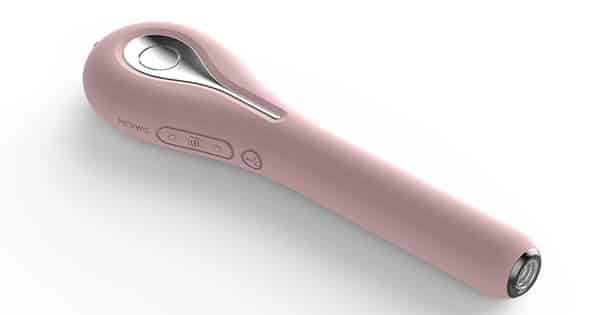
A connectable dildo suffers from numerous vulnerabilities that make it trivial for attackers to steal users’… well, “private” data.
The “Siime Eye,” which comes to us from Svakom, is aptly named in that it’s a $250-vibrator that for some reason comes with… a camera.
All a user needs to do is turn on the device, connect to its AP (SSID: “Siime Eye”) using the default password (“888888”), open the Android or iOS app, and “install” it. From there, they can view the livestream or take pictures and video.
Tantalizing, I know.
Turned on by other researchers’ work involving smart sex toys, Pen Test Partners decided to examine Siime Eye. They quickly found a hard-coded IP address that accepted blank admin credentials. An attacker can therefore easily access the device’s Wi-Fi AP, which is configured as an access point. The AP name is also static, meaning someone could technically geolocate other users via a wardriving site like wigle.net.

But that doesn’t come close to the worst of it.
With the help of some eBay clips, a BusPirate, flashrom, and a Stanley knife, Pen Test Partners dumped the dildo’s root Linux filesystem, exposed the contents of /etc/passwd, and wrote themselves in as a root user. They then grepped for “root” after poking around on /bin/camera, one of the filesystem’s binaries. This process revealed reecam4debug, the sex toy’s telnet password.
The researchers explain in a blog post what attackers could do with their exploit:
“In this case, overexposure of system services means we could write a rogue application, compel a user to connect our app to the device using the default credentials, and then use the already-inbuilt functionality to perform unsolicited actions on the device. If we could get a user to connect their device to their home Wi-Fi, we (or any website loaded within the user’s home network, in a JavaScript drive-by) could siphon all video data, Wi-Fi passwords, and a list of local networks off it and send it somewhere unsolicited.”
Bad actors could take it one step further. If they could gain physical access to a Siime Eye and access the AP, they could almost certainly establish a root shell and gain access to an unprotected version of the video stream.
It’s bad enough there are IoT products our there that threaten our kids’ privacy.
But this device rests on a whole other level of insecurity. Users should therefore think long and hard (pun intended) about whether they want to keep using Siime Eye.
If the device is indispensable, they should change the Wi-Fi password to something complex. They can also try to contact Svakom, but as Pen Test Partners didn’t receive a response after three separate messages, that might be an unfulfillable fantasy.
You can hear further discussion about this latest example of IoT security insanity in the “Smashing Security” podcast, hosted by Graham Cluley and Carole Theriault.

Show full transcript ▼
 This transcript was generated automatically, probably contains mistakes, and has not been manually verified.
I certainly wouldn't want to share that kind of information with you, would I? Let's be honest.
They are scouring both the regular web and the darkweb using sophisticated technology, finding out all about emerging threats.
And you can sign up to their daily newsletter and get the latest insights at recordedfuture.com/intel.
Hello, hello, and welcome to another episode of Smashing Security, episode 15 for the 6th of April 2017. And as always, I'm joined by my buddy Carole Theriault. Hello, Carole.
And now I believe you represent the Anti-Malware Testing Standards Organization, AMTSO.
And we talk about testing and we try to come up with better, more reliable, more accurate ways of testing things.
And we're currently in the process of putting together the first set of official standards for anti-malware testing.
How long have anti-malware products been around? Almost 30 years or so, isn't it?
That's the problem, is that if a test isn't done well and the results from it are not useful to anybody, you know, they're misleading the consumers and they're also misleading the people that are making products.
They're not going to be able to fix problems that they don't have any information about.
Well, what we try to do is we look back over the last week in computer security and some of the stories which have tickled us, some of the ones which have caught our interest, we have a little chat about those.
So I've got a rather interesting one to begin with. Oh God.
We are talking about — is that a trunk? John, John, John, Carole, please, both of you behave because this is a serious topic.
And for some years, some of the world's leading boffins and scientists have been working on the area of teledildonics.
And what they are interested in doing is connecting sex toys to each other via the internet or to their, I don't know, to participate in parties, I imagine.
And you can probably tell where this is heading because the danger is, of course, that people will be connecting sex toys to the internet which are vulnerable and have flaws and exploits which hackers could exploit.
And there is a group of penetration testers called Pentest Partners, a guy called Ken Monroe—
The Siime Eye. S-I-I-M-E Eye, as in eye in your head. You sure it's not See Me? Oh, See Me.
That brings tears to your eyes, doesn't it? $250 vibrator that for some reason or another comes with a camera.
I don't think so. If you were able to see something, that would suggest some kind of medical emergency, I would imagine. If there was light in there, I don't know.
Now, these devices come with a standard access point SSID, which is SeeMeEye, and they have a default password, of course, all the 8s.
Just type in lots of 8s, and you can access it via the associated Android or iOS app. And once you've done that, you can view the live stream.
I don't know if you can actually send it straight to Facebook or whatever. I know it sounds quite tantalizing, doesn't it?
But you have to ask yourself, you know, why would you want one of these?
And what's more, as well as the camera itself, as well as it being a Wi-Fi access point, why would you also want that vibrator to contain hidden functionality to connect itself to Skype?
So I just don't understand— I still don't understand why there's a camera at the end of the device.
And maybe I don't understand this properly, though that just sounds like a medical—
Why are we even discussing this?
Anyway, look, the point is that the Internet of Things has had yet another massive fail where people are putting devices on the internet which are insecure, which can be remotely hacked.
In fact, Pentest Partners, who looked at this particular device, by the way, they must have the most fun job in the world.
They're looking up the perviest gear which is internet-enabled and working out how they can— Fun job?
Believe me, they are loving it because they were even working out that because the access point name is static, you know, basically if you look on your phone and you see SeeMeEye in your vicinity, you know somebody's up to— Right?
You know that that's going on. And if you via a war driving site, you may even be able to work out where they actually are and technically geolocate other users of this device.
But, you know, what's happening is this: plenty of devices are being made, they're internet-enabled, the security is a joke, and privacy is being put at risk.
People can spy upon you. Now, whether this is something which would alarm you if you're using such a device or not, I don't know. But frankly, what is happening to the world?
And can I get off? It's horrendous. And when do we need some kind of legislation? Do we need a testing standards organization to test internet? John, forget anti-malware.
Maybe you should be looking at IoT and particular devices.
You mentioned actually in your bit there, you said you can connect using your iOS or Android app.
Everybody knows that those are the two options really when it comes to smartphones, at least. You're either Apple or you're Google.
Which not a huge number of people know about, but it's been in development for five or six years at least.
It's based on Linux and it's part of this big long project that's part of the Linux Foundation, but it's backed by various companies that are involved in—
It's a huge deal for Samsung because I think they're basically betting on it being their future and replacing their reliance on Android.
He called it a hacker's dream.
One of them was in the Tizen Store app, which is their app store, which basically gives you complete control over the entire device.
So some of the data that was being sent from devices was not encrypted properly and some of it was, some of it wasn't. It was just a bit of a mess really.
I think there's obviously a lot of — I mean, it's a, to me, it seems like a good idea to have a dedicated operating system like this that all lots of different people can use.
Cause you know, it's good to have a bit of convergence, but you need a bit of diversity too.
I think at the moment, the situation is that somebody who makes dishwashers or microwaves suddenly decides, oh, we need to be part of the Internet of Things.
So we'll just slap some stuff in there and make it online. And that's not really their area of expertise.
So it would be good to have somebody that was making something that these people could use.
So if they get something off the shelf from, for instance, Samsung, then that sounds sensible.
But of course, if you converge to all use the same code, it better be bloody good code, which is secure.
So how they've missed, you know.
Well, that's another part of it actually, that I think a lot of people when this story came out that he'd found this huge long list of issues, I think people were assuming that a lot of it was the older stuff that had been inherited from these earlier projects.
It's like, woohoo, you know, that's—
Have you?
But obviously that's not really been picked up yet.
I hope Samsung will fix these problems quickly, and I hope that they'll get some decent penetration testing done and vulnerability researchers looking at the code to make sure that it's— if they're really going to push forward with it, that they make it much more secure in the future.
You know, like you'd have a specialized, you know, just an address, just a form, but we know it's going to the right place and going under the right eyes.
Because I assume that's what's happening, right? The person who's actually opening that email doesn't really understand it and just lets it drop.
Well, this is another argument for having this kind of centralized ubiquitous platforms that people can use is that if you are, if you're a maker of toasters, you probably don't have a bug bounty program.
We all worked together at a time, long time ago, and you guys will remember that we had cards that we had to swipe to get in and out of the building, to buy lunches, to attend events, that sort of stuff.
And do you remember when you'd forget your card or you'd put it through the laundry or you dropped it in your car and you couldn't find it?
And then it was a big deal because you'd have to try and get a temporary card, but there was never enough temporary cards, so then HR would have to run around and make you a new card, or you wouldn't have a card at all and wear this big kind of thing around your neck to say you're an idiot.
And I know what, I've— some companies even charge you now for losing your card, so that's also a big pain. Thank God I'm not having to wear those.
Anyway, so this is all big pain in the butt, but was it painful enough, gents?
Now they offer to implant its stuff with NFC, so that's near-field communication microchips, right? It's the same kind of things you have in your credit card.
And it basically is there to transfer small amounts of data between it and other chips, okay?
So this is gonna be sharing information you wanna purchase your lunch or you wanna get in and out of the building or into a certain area of the building.
Now, the chips are about the size of a ping pong— no, I'm kidding. I'm kidding, I'm kidding.
They're the size of a grain of rice, and they are injected with a syringe into the fleshy part of your hand right next to your thumb. I bet you it does feel like a ping pong.
Seriously, it's a grain of rice.
Okay, and Epicenter hold monthly events where attendees can receive the implant.
So what is the chip collecting? My location, what I buy, where I go, when does it turn off? How big is the field of monitoring? Think of, you know, what about after hours?
What about security? You know, it's of course it's gonna be completely unhackable and no one will ever hack NFC and that's never happened before. And what about unfair dismissal?
All the information is on this, and all of us have it, you know, some kind of grayer bits, you know, where we may have left work early one day and not got clearance or one of these things.
And now this could be used by companies to kind of go, oh, look, you left early on Wednesday and we have no record of you getting—
Do you end up with lots of chips in your hand? Yeah, do they reprogram the chip?
I just think it's, why don't they just put barcodes on our foreheads with our number, our citizen number, and just scan us on the way in?
Why don't they just do that rather than putting chips in us?
Well, hello, you are part of the future. As long as you don't die right now, you're going to be there. You don't need to do this. I just think this is a bit insane.
It's a real nice Pandora's box.
You know, we have cards that we use to get in and out of offices and to buy things in office canteens, but we also have cards that we get money out of machines with or pay for things in shops with.
So I would imagine in future these people probably want us to have a little grain of rice that identifies us whatever we were doing.
And we could use to do our shopping or to activate our phone or whatever, which is the future.
There we are saying, why do you need a vibrator with a camera on it, which is wireless as well?
Why does Samsung need to create this alternative operating system, which is full of vulnerabilities and why are they injecting chips into people?
Why can't we go back to the old days and all this?
It seems that I would worry actually if I was working at Epicenter that there'd begin to be a little bit of peer pressure.
Oh yes, we have a monthly meeting where we try and convince more of our employees to have this. It's like, bugger off.
Well, you can leave your card at home and if you're trying to do something where you don't want to be monitored by your business, you can actually just leave the card behind.
Whereas if it's embedded in you, it's part of your identity and no one can steal that from you.
Please subscribe to the podcast there, and then you won't miss any future episodes which come out.
And you can also subscribe on Google Play Music and Overcast and Stitcher and TuneIn and iHeartRadio, all kinds of other places too.
We're @SmashingSecurity, that's smashing without a G security. And until next time, bye-bye. Oh, you're just not going to say bye-bye.




Do we really need Smart Dildoes?