


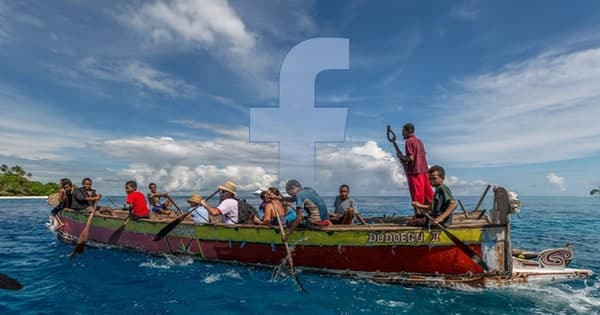
The country of Papua New Guinea is reportedly planning a month-long national ban of Facebook.
Why? To research the effect that the addictive social network has on the South Pacific island’s populace, and to root out “fake users”:
Communications Minister Sam Basil said that the shutdown would enable the department and National Research Institute to conduct further research on how the social network was being used by users.
“The time will allow information to be collected to identify users that hide behind fake accounts, users that upload pornographic images, users that post false and misleading information on Facebook to be filtered and removed.”
“This will allow genuine people with real identities to use the social network responsibly,” Mr Basil said.
The Minister said that the department could better analyse the positive impact it would have on the population during the month-long shutdown and weigh the impact of progress without or with its use.
There certainly could be some positive impact in terms of productivity if residents of Papua New Guinea can’t get their Facebook fix, but it would clearly be bad news for companies which use Facebook to provide customer support or raise awareness about their products.
But the report about Papua New Guinea’s Facebook ban is frustratingly devoid of detail. When is this ban planned to begin? How will the ban be implemented? Couldn’t simple use of a VPN trick whatever is intending to block Facebook into thinking the user is going somewhere else entirely? Or will VPNs be blocked too?
Furthermore, how will the Papua New Guinea government measure the impact of the experiment? A month doesn’t sound like a very long time to measure the long term impact that deleting Facebook would have on islanders.
And what’s all this about “identifying users who upload pornographic images… and post false and misleading information”? How would a Facebook ban help with that? If Papua New Guinea is worried about “fake news” surely there are ways to measure and research that without issuing an outright ban on Facebook?
It’s all rather baffling. At least, until you see what else Sam Basil has to say:
“We can also look at the possibility of creating a new social network site for PNG citizens to use with genuine profiles as well.”
“If there need be then we can gather our local applications developers to create a site that is more conducive for Papua New Guineans to communicate within the country and abroad as well.”
And there you have it. It’s very easy to read into this that the-powers-that-be in Papua New Guinea are not very keen on Facebook, and in particular profiles that may be posting “false and misleading information”.
It would be easy to conclude that if the government’s month-long experiment concludes “irresponsible” Facebook use is having a negative impact on islanders’ social well-being, security and productivity, that it may use it as a springboard for creating its own version of Facebook.
A government’s own version of Facebook, with confirmed identities, where you would always know who said what and (presumably) who might be saying something that is critical of thoe in authority…
I’m no fan of Facebook, and I think everyone taking a break from Facebook is a healthy thing, but I’m not sure I like where a government-backed Facebook clone is heading.
Let’s hope instead that Papua New Guinea is as concerned as the rest of us should be about how Facebook users can find their personal information exploited and opinions unduly influenced by malicious actors.
Papua New Guinea currently has low internet and Facebook penetration compared to much of the rest of the world, so if it does wish to take action against the darker side of social media then now is possibly a good time to do it.
Just don’t build something worse to replace it.
Show full transcript ▼
 This transcript was generated automatically, probably contains mistakes, and has not been manually verified.
Cluley in bed about his annoying Canadian co-host the other day. Smashing Security, Episode 80.
Country Bands Facebook, Eavesdropping Alexa, and Pornhub VPN with Carole Theriault and Graham Cluley. Hello, hello, and welcome to another episode of Smashing Security, episode 80.
My name is Graham Cluley.
And so writing articles, security presentations, pretty much the things you do, but in a much smaller scope, I think.
I'm guessing you might, in recent weeks or maybe even months, spoken about something called GDPR. Is that something that German people care about at all?
Over 1 million files are uploaded every day by folks analyzing malware and attempting to determine what different antivirus products call a sample.
But you can do much more than that with VirusTotal Intelligence, which helps you get more context about your alerts through advanced malware threat hunting, relationship and behavioral visualization, as well as historical analysis on billions of malware samples.
To learn more about how VirusTotal Intelligence can help you, visit virustotal.com/learn or email the team at .
And be sure to say you heard about them on the Smashing Security podcast. And welcome back.
Well, as normal, we've been looking back over the computer security stories of the last week, and my story involves the letters PNG.
Now, Tommi, Carole, could it be Portable Network Graphics? PNG, what could it stand for? Persona non grata, maybe? Pencil-necked geek?
They have 3 official languages: English, Hiri Motu and Tok Pisin. Oh, please, please. This isn't the kind of podcast where we make fun of foreign words, right?
They don't say exactly when they're going to do this, but their intention is to find out and research the impact that Facebook is having on their population and to root out fake users.
I mean, it's good news maybe for people who might be addicted to it, because maybe this is the push that they need to separate them from their addiction.
It's maybe bad news for any company or organization which may use Facebook for a positive purpose.
But Communications Minister Sam Basil said that the shutdown would enable his department to conduct research into the social network.
And what they want to do is find out who hides behind fake accounts, who are the users that upload pornographic images, who's posting false and misleading information.
Now, I don't understand why you have to close down Facebook or prevent people from accessing it to work out who might be behind a fake account.
I don't see how that actually helps the government.
But then there's this other kind of we want to weed out— they're not trying to block user accounts. We want to know who is behind these accounts.
So it looks a bit like a witch hunt.
And if so, how's that going to prevent people with VPNs from accessing Facebook because they'll be able to pretend that they're going somewhere else entirely.
So unclear how that's going to work. Are they going to block VPNs as well?
They're just going to switch over to Instagram and post up a non-smiley selfie or something. They're hardly going to storm the streets, are they, with placards?
Sam Basil has said we're going to look into this, what the impact is and how PNG citizens could use Facebook with genuine profiles.
And he says if need be, maybe we need to get some of our local population and developers, or 7.8 million people who live there, to create their own version of Facebook which is more conducive to us and the people who live on our island.
So what he's actually saying is maybe we should have our own Facebook and not use that one.
And that's what makes me a little bit suspicious about this, because they're worried about people posting false and misleading information.
It's hang on, the government are worried about what people are posting and how it could be false and misleading, and then they're beginning to say, well, maybe we need our own Facebook with confirmed identities.
That presumably is going to make it harder for someone who has something to say which is critical of those in authority in PNG to post those messages on a new network.
I think, because we always advise people not to log into public Wi-Fi.
The surprise is actually the ones who are providing the VPN service.
Oh, with all the encryption, everything you dreamed of, with apps for iOS, for Android.
So if they're in a cyber cafe, yes, they will be able to connect to this site and people won't know where they're going, other than looking over their shoulder, obviously.
I'm just looking at an article right now that says could have given masturbators some sleepless nights.
They run this decentralized DNS service or utilizing these instead of relying on just one service. And on several other occasions, their IT infrastructure has been praised.
So besides the fact, surprising fact, that a porn website service may launch a VPN service, actually they have proven to me that they might have infrastructure which is reliable.
And it's the adult entertainment business which is really pushing this technology.
So I'm not surprised necessarily that their site stayed up, as it were, during the Mirai attack when others went down.
But it's also— so presumably with this VPN, you won't use it simply to go to Pornhub, will you?
You could use it to go to BBC News or, you know, iPlayer or any website on the internet, right?
Once you want to install it on your Mac, for instance, or your Windows, you need the premium version. That requires a subscription fee, but you also get 24/7 support.
But nonetheless, I mean, the graphics itself, they aren't differing from other VPN services. So there's no connection to Pornhub actually in the GUI.
I don't know about the bill you get because honestly I didn't use the service yet.
Will that monetize itself in some fashion, maybe with some advertising, some targeted content?
I wonder how also this will fit in with some things which are beginning to be introduced in the UK, where they're really looking for an identity scheme to confirm that people are adults before they access pornographic websites.
And this may be part of Pornhub's move attempting to deal with these sort of systems being corporate in different countries, because this would be a way, of course, for them to have your details and say, yes, you've created an account, you've given us your credit card details, you confirmed that you're over 18, for instance.
I tend to feel much more comfortable if I'm giving them money because then they have a vested interest in not trying to monetize my data in some fashion.
I'm talking about conversations that are definitely not meant to be overheard, let alone shared.
Maybe you and your main squeeze are fighting about money, or you're gossiping about a neighbor or colleague, or you're chatting to your kid about a problem at school, or maybe you're just about to get your freak on, if you know what I mean.
If you were somewhere public, you'd probably look around first to spot your wiggers. But shouldn't you be able to assume privacy in your own home or in your bedroom?
So check this out. An Oregon-based woman named Danielle recently got a serious privacy wake-up call. She and her husband were chatting away in their bedroom.
So Dave does the right thing and tells Danielle's husband that he received this weird audio recording from them out of the bedroom. Danielle's husband is like, no way.
And Dave is like, yes way, you guys were talking about hardwood floors. And husband goes, oh yeah.
All the while probably thinking, "Fuck, fuck, fuck, at any point did I call Dave a douche?" Right?
No, like what? Did you?
Now, this is a big point of contention because Danielle said the device was at 7 out of 10 in terms of volume and she was right next to it and she didn't hear it say anything.
Anyway, there was a heck of a lot of coinkydink mistakes here that happened one after another. And I have yet to see one sorry for Amazon.
And why is it the big guys never own up and mea culpa when they fuck up? I mean, who else is liable here?
I mean, just think about it, Graham. You're in bed with Mrs.
Cluley bitching about your really annoying Canadian co-host, not for the first time, only for the recording to be sent directly to me.
And the message might be so awful that I decide never to do a podcast with you again. And think of the suffering that would cause the world.
Cluley in bed about his annoying Canadian co-host the other day.
And we have mics on our phones, our tablets, our computers, our televisions, our home assistants, our cars.
And you, Graham, you keep accidentally FaceTime videoing me from your bathroom, for God's sake. Video!
Only when I get in the shower for some reason.
So number one, I suggest don't buy a device where you can't mute the microphone on it, right? So just check that that's something that you can actually toggle on or off.
Apparently on these Alexa devices, don't grant access to your contacts and don't enable calling and messaging.
Apparently if you do and now you wish to disable this, you need to call Amazon on the phone. If we're talking about Echos, this is according to John Gruber.
You can go to the smashingsecurity.com show notes for this episode, and I've got a link to a Verge article on how you can do that.
And maybe it's worth not having a listening device in rooms where you want to have a private conversation.
I don't know, I'm really seriously thinking about designating a room in my house as almost a safe room, one where smart devices are banned. I'm serious.
So on my iPhone, for example, you would go to privacy and select microphone and review which apps need to have the microphone turned on and turn off everything you don't trust or don't use regularly.
And then when you go and have a look, you're like, crap, you know, why does that need my location? You can decide to deny it in future.
I know there's not a ton of these, but I'm not moved yet from my stand of not having one of these in my house yet.
Over a million files are uploaded to VirusTotal every day for analysis and to determine what different antivirus products call them.
But you can do much more than that with VirusTotal Intelligence.
VirusTotal Intelligence helps you get more context about alerts through advanced malware threat hunting, behavioral visualization detection, as well as historical analysis of samples.
Learn more by visiting virustotal.com/learn, and be sure to let VirusTotal know that you heard about them from the Smashing Security podcast.
And welcome back, and you join us at our favorite part of the show, the part of the show that we call Pick of the Week.
Could be a funny story, book that they've read, a TV show, a movie, a record, an app, a website, a podcast, whatever they like.
Doesn't have to be security-related necessarily, and it could be. And you know what, mine this week is a little bit security-related.
And you're all familiar with those little widgets when you select a password on a website which gives you some indication.
It says, oh, this is a rubbish password, this is a weak password, this is an okay password, this is average, or that's really fantastic.
Well, the Passive Aggressive Password Machine basically takes the mickey out of the quality of your password in fine style.
Now, I would not recommend entering your real password there. You should never enter—
Another one says, "You're joking, right?" So you get hundreds of different responses, and it's quite a fun little way, I think, of raising awareness in your organization about the need for sensible, strong passwords.
And it just tickled me a little bit when I came across this.
It's not going to set the world on fire, unlike most of my picks of the week, which frankly do change the future of civilization and set the world on a whole new axis.
This is simply the passive-aggressive password machine, and it will entertain you for approximately 20 seconds. And that is why it is my pick of the week. Tommi, over to you.
What's your pick of the week?
She calls herself collection specialist at the Costume Institute at— and now we come to my pick of the week— instagram.com/eBayBay. eBay before anything else.
You may wonder what you find there. Quite entertaining content, all coming from eBay.
And basically it's a mannequin with lots of hair all over its face.
And at the moment, this is how it plans to make money. So it's beta testing a system to reward publishers called Brave Payments.
This system would allow a user to set a budget that they're willing to donate to websites they spend time on.
Brave would effectively calculate the percentage assigned to each website through an algorithm that maybe says how often you go there, how long you stay there, how many services you use.
And then the publisher of the website would receive a transfer in cryptocurrencies should they choose to opt into the system. So apparently all this is going to be optional.
And I kind of like this idea. Now on top of that, it's really quick. I noticed a difference with the VPN turned on compared to other browsers I've used, other browsing apps.
You can assign it to a variety of different search engines. So it's a nice big list from things like Bing and Google all the way to DuckDuckGo and Startpage.
And there's a whole host of privacy and security features that you can toggle on and off to stop tracking and ads.
And I suggest maybe if you want to learn more about the security features, you go to another security podcast called The Complete Security and Privacy Podcast, episode 63.
If you want to learn more about, you know, a deep dive into the security features of Brave, check it out. And I've been using it for a few weeks and I love it.
And my backend guru of a brother, an Android user, also gave it a thumbs up. Mind, he is a bit annoyed about being the butt end of all our jokes last week.
Tommi, if people want to follow you online, where's the best way for them to do that?
Twitter wouldn't allow us to have a G. And you can go and buy stickers and t-shirts and all kinds of goodies at smashingsecurity.com/store as well.
And until next time, I guess all I have to— oh, one thing we have to ask you to do, if you like the show, rate us on Apple Podcasts. It does help new listeners discover the show.
But if people wanted to see us, they could probably find all the details out on our website, right?



It will be an interesting experiment, especially if it confirms the prediction that Facebook usage is inversely proportional to productivity…which has certainly been my experience.
Concerning the inconvenience to companies that rely on Facebook for customer support and interaction, they need a wake up call anyway. I can understand the utility of Facebook as a vehicle for raising awareness of products and services. But when I find a company that relies exclusively on Facebook for support or other interactions, I'm outraged. How dare they require me to compromise my privacy and security for normal customer interactions?
Still, Facebook unquestionably fills a market need. The question is whether a state-run Facebook clone is a better option. The presumption that political states are qualified to provide the service of government (protection of lives and other property…including privacy) has been at the root of much misery in the past—a condition that continues into the present.
This one is worth watching. Maybe Papua New Guinea can actually design & operate a social networking service that manages to avoid the excesses of command-and-control statism, but I'm skeptical. I'll have to see it to believe it.
Was the press release made available in the other official languages of PNG? Wikipedia says that Tok Pisin is the most widely used.