


What’s happened?
Equifax has announced that it has been hacked, and approximately 143 million US consumers may have had their names, social security numbers, dates of birth, addresses accessed by criminals. In some instances, driver license numbers have also been accessed.
143 million? That’s just under half the population of the United States.
Approximately 209,000 US consumers have also had their credit card numbers exposed, and about 182,000 other US consumers have had other personal identifying information accessed.
An unstated number of UK and Canadian residents have also been put at risk.
Sounds disastrous. What does this Equifax company do?
They’re a giant consumer credit reporting giant. The kind of company that can stop you from getting a loan, or accepted for a mortgage, if you have been careless or unlucky with your finances.
They also offer identity theft protection for a business’s customers and employees after it has suffered a data breach.
Oh, so you’d expect them to know a thing or two about the importance of protecting personal information?
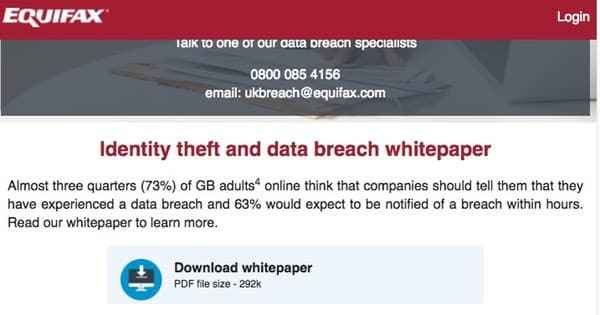
Right. In fact, they’re offering a whitepaper right now where they underline that most consumers want to be notified of a breach promptly:
Almost three quarters (73%) of GB adults online think that companies should tell them that they have experienced a data breach and 63% would expect to be notified of a breach within hours.
Notified within hours? How long did Equifax take to tell their affected customers?
Equifax found out about the breach on July 29th, and told the world on September 7th.
How many hours is that?
By my calculation it’s been 960 hours (40 days) between Equifax finding out about the breach and warning the public.
What is Equifax doing about it?
Well, the CEO has made a video expressing his regret and apologising:
Equifax is offering free credit file monitoring and identity theft protection. Be aware, however, that TechCrunch is reporting that if you sign up for the protection service you may be waiving your rights to sue Equifax.
Hang on. So the company which lost millions and millions of people’s identities is asking me to hand over my information so they can tell me if my details are at risk? Isn’t that, umm, a little screwed-up?
Yeah, and you thought 2016 was a really bad year.
There are numerous reports that a page setup by Equifax to tell users if they might be affected (after entering their surname and last six digits of their social security number) fails to live up to its promise.
EQUIFAX: we may have leaked your SSN
ALSO EQUIFAX: give us your SSN to see if we leaked it— malice ghoulpus (@alicegoldfuss) September 7, 2017
Quite what UK consumers are supposed to do – we don’t have social security numbers over here – is unclear. I guess the fact we don’t have social security numbers is good news in so much as we can’t ever lose them.
Who’s to blame for this?
We don’t know who the hackers are, and obviously they – ultimately – are the ones who committed a crime and are responsible for the breach.
However, many will be watching with interest to see what details Equifax will share about the details of the breach and why it took them so long to warn consumers. There will also, no doubt, be many interested to observe what impact the breach has on Equifax’s brand and reputation.
Data breaches can hit hard at all types of organisation, and there’s no such thing as 100% security. However tempting it is to give Equifax a hard time, we have to remember that they are also victims of a crime.
But if a company that dedicates so much effort into promoting its identity theft monitoring services finds it has itself been hit by a colossal breach, there’s a clear message for all businesses that no-one can afford to be complacent.
It takes years to build your company’s reputation and earn your clients’ trust, but may only take minutes for it to mortally damaged.
Apparently, the punchline for every cybersecurity joke from now on is "Equifax".
At least Sony will be pleased.
— Graham Cluley ???????? (@gcluley) September 7, 2017
I think I’m affected. What should I do?
Well, you could try changing your name and date of birth and social security number. What’s that? Oh dear… not so easy is it? This is why it’s so serious when companies lose your personal identifiable information. A password you can change, your personal details are probably going to always be the same – whether you like it or not.
Where can I find out more?
Equifax’s dedicated website to deal with the aftermath of the breach: www.equifaxsecurity2017.com
For more discussion on this topic, be sure to listen to this episode of the “Smashing Security” podcast:
Show full transcript ▼
 This transcript was generated automatically, probably contains mistakes, and has not been manually verified.
Identifying, prioritizing, and managing vulnerabilities all the way through to remediation is not only possible, it can be simple right now.
Build a vulnerability management program that works for you with InsightVM by Rapid7. Get started with your free 30-day trial right now.
Go to www.rapid7.com, and thanks to Rapid7 for supporting the show. Smashing Security, episode 42. Equifax, Blueborn and the iPhone X with Carole Theriault and Graham Cluley.
Hello, hello and welcome to another episode of Smashing Security number 42. My name is Graham Cluley and I'm joined as ever, by my good chum and co-host, Carole Theriault.
Hello, Carole, how are you?
You are the founding member of Host Unknown, and you're regularly espousing wisdom on behalf of AlienVault as well, all things computer security, right?
And well, this one was pretty much a given, wasn't it? I think the security story of the last week is the enormous monumental screw-up, which is the Equifax data breach.
Now, if you're not familiar with Equifax, they are a consumer credit reporting giant.
They're the kind of company who can stop you from getting a loan or being accepted for a mortgage if you've been careless or unlucky with your finances.
And it's not so much that you are engaging Equifax. You may be going to your mobile telephone company or your mortgage company and trying to open an account or get a loan.
And they will consult a firm Equifax, and they will say, oh, what's this person's credit rating ?
And particularly if they're trying to improve their credit rating or find out if they have a particular problem, then yes, they might well be doing it themselves as well.
But I think many people won't even realize that Equifax have been storing their details. And that's a problem.
But this is particularly bad because, like I said, you didn't give your information to this company.
And Equifax, one of the businesses which they're in, is in providing identity theft protection.
Because we've signed you up with Equifax, who are going to protect you. And you say, oh, goody, goody, gumdrops.
I'd like to know they've got my information to see if it's been misused. Well, bad news. Now they've lost it.
143 million in the US, an unknown number in Canada, up to, I think it's 44 million UK consumers as well.
And meanwhile, the hackers potentially are taking that information and they're taking out loans in your name or they're opening up accounts in your name and your credit rating is damaged.
So fairly disastrous.
It then took them 40 days before going public and said, "We've got a problem here." So Equifax is asking people to sign up to go to its website to find out if they are amongst those being breached, to enter their surnames and the last 6 digits of their Social Security number.
And then they say, we will tell you if you've lost your identity or not. Now, there's a few problems with this.
One of the problems is, as ZDNet discovered, you could enter any old rubbish onto that form. You could give your surname as Test and your Social Security number as 123456.
And the system would say, oh yeah, it looks like you may have been impacted.
And sometimes you would put in the same thing on multiple attempts and sometimes it'd say, yes, you may have been impacted. Other times it'd say, no, you haven't been impacted.
So that's pretty rubbish, isn't it?
If you go to the website, you've got a problem because us Brits don't have Social Security numbers. So how are we meant to find out?
So I went to Equifax.co.uk and I thought, oh, well, they'll have British-specific information there, won't they?
If you go to Equifax.co.uk, there is no mention of the breach whatsoever on the front page.
And they're saying that if you want to know about identity theft, they can sell you a solution to help you do that kind of thing. And it's, what? They've had 40 days.
And the response has been so ramshackle. It's been diabolical.
And my fundamental problem with this, I think one of the things that really annoys me about this is they are putting the onus on consumers to hear about this breach and to visit their website and to enter their information to find out if they've been breached.
Why aren't they contacting people and saying, "We believe we've lost your information"? Shouldn't they be informing us if they've lost our details rather than us contacting them?
Cluley?" And you would say, "Yes," and go, "Is your security number this?" Say, if you had a Social Security number.
So how do they identify you without revealing their information, I guess.
I'm not saying that it's an easy thing to do, but I think the solution they've come up to is completely shambolic and seems to be very badly done.
And in the United States, it appears it's awful. There are reports now that data may have leaked in other countries as well, and there may be other problems.
Brian Krebs has written today about an Argentinian Equifax portal where people can log in apparently with username admin, password admin, and get hold of lots of information, including details of Argentinian consumers.
So it's just dreadful security appears to be in place.
No surprise then that the lawyers are queuing up to sue Equifax, they are the ones who are actually going to get rich from all this.
And that's what the criminals would have done.
They would have queried the database and unfortunately, there clearly wasn't some kind of limit as to how much information they could collect.
Someone has set up an online chatbot which used to take action over parking tickets and things. It's been customized now.
So you can go online without involving any lawyers, and it will lead you through the process of suing Equifax for up to $25,000. No lawyers need to be engaged at all.
So technology has been put to good use.
But I really dislike the idea that Equifax's solution to this data breach is to try and get people onto their own identity theft protection program.
It's like, why would I trust you with my details?
You can try and contact Equifax UK, or if you're elsewhere in the world, to find out how on earth you're supposed to query them without a Social Security number and ask what they're planning to do about it.
You may want to sign up for identity theft protection.
And I think obviously you can sign up for other identity theft protection services. The other thing you can do is you can freeze your credit rating, what's it.
David Bissett on my website has written an article all about the different things you can do which simply prevents other accounts being created and access into your credit rating, which can prevent scammers from exploiting your identity in that particular way, which could be a good response as well.
But I think most companies need to learn the lessons from Equifax because boy oh boy, their share prices suffered and to my mind, quite rightly too.
We have a massive breach, there's outrage, we say things must change, share price dips maybe for a day or two, and then 6 months, a year later, it's ancient history.
Maybe they don't want to hear it over the bottom. Maybe they need a swift kick somewhere else.
But something needs to happen for other companies to get a very clear message that this isn't acceptable. We've got things GDPR coming along.
So if someone takes out a mortgage in my name 6 months down the road, you know, how do I actually prove that they actually got my details as part of this breach?
And therefore Equifax will be held liable for it. I can't really prove that. So the actual damage is, it's, you know, provable damage is very difficult to show.
So it becomes very difficult for any real impact to happen.
And you say, unless regulators actually step in and really hit them where it hurts, which is in the wallet, I doubt much will change.
I mean, you said, 6 months down the line, this information could be abused in a year, 2 years, 10 years.
So Javvad, what have you got for us this week?
They use it for their wireless headphones, their wireless keyboards and all other — they're sort of like—
So maybe it's something I should consider going forward.
But there are a bunch of clever researchers at an IoT security company called Armis, and they've recently released what they call a Blueborne vulnerability, which is an attack vector that uses Bluetooth connections to take control of your device.
So it could be your phone, your desktop, your laptop, or any one of the gazillion sort of IoT thingies that you have lying around your home that use Bluetooth.
And so this is every vendor. So it's Windows, Apple, Linux, you name it. If it's got Bluetooth, it's—
So it's seeing a lion that's really majestic in the wild three seconds before it rips your head off. Wow. So it can do remote code execution on the device.
It can man-in-the-middle the connection and it can hop from device to device over the air.
Is the fact that if you were carrying an infected Bluetooth device and you went into a building or an office, for instance, it would then seek other Bluetooth devices which it doesn't have to pair with, but it can infect those as well.
And it spreads and it spreads and spreads.
I was just thinking, how heavy would it be to create an infected payload and attack, stick it to your drone and fly it over some buildings? Right.
So some patches have been released, some are in development, but you know, in honesty, a lot of devices just won't receive patches.
If it's an IoT device, a lot of them just don't have a mechanism.
If you're running an old phone, an old Android version that can't run the new ones, you're not going to get protected.
They've only sort of gone public now with the announcement of the vulnerability because they wanted to give it time to get onto people's computers.
Apple devices prior to, I think if you're on iOS 10 or later, certainly you're protected with that.
Android, yes, Google has released a patch, but we have this age-old problem with Android of so many Android smartphones not receiving operating system patches and being protected.
And they may be potentially the ones which are most at risk from this. Great piece of research by these guys. We have to hope obviously that no one tries to exploit it.
Thankfully, there are some patches, but as you said, IoT devices and old Androids may really struggle and they're going to be the ones which are most at risk.
You know, beyond saying, well, turn off Bluetooth or Wi-Fi or anything you don't need when it's not needed, there's not really much else you can do.
You know, I can't turn off the Bluetooth on my keyboard, otherwise it stops being a keyboard. There is no wire option.
And, you know, I've got a phone which connects via Bluetooth to my car so I can listen to the Smashing Security podcast as I'm driving.
That's what I listen to most of the time, to be honest. Bluetooth is an important part of my life.
I'm glad that my devices are at least patched against this vulnerability, as far as I know. I don't know about my keyboard.
What I'm impressed by is that these security researchers didn't have to produce a very good logo for this, didn't they?
And they've done a couple of natty videos as well, which we'll link people to so you can see exactly how this operates.
And they have a demonstration with one of how it can be exploited on Android as well. So nice work by them.
Thank goodness they did some responsible disclosure, but a bit of a shame that there are devices out there which will still be vulnerable.
We just have to hope that a lot of the hackers out there actually don't pay that much attention to it and maybe look for other ways to infect devices instead.
I can walk into this corporate office and I can launch this attack and that would look really good on the report.
They could send someone in with an infected device in his pocket, doesn't have to plug it into anything, and bam, it's looking for Bluetooth connections.
They're not gonna be able to control the end of it unless they control the threat itself when it calls home.
It was obviously designed to mess up a uranium enrichment facility, but it ended up spreading much, much further.
You know, so it's World War III compared to Armageddon.
If you're using devices which don't have some kind of update infrastructure, then you need to start looking at that because problems like this are only just going to carry on happening, aren't they?
We talked about the overhauled handset so that there'll be a curved glass front and no home button, right? So there's only the on/off button. There's a new camera as well.
And of course there's the facial ID login feature. So we obviously complain constantly about the pain of password management.
And our friends at Apple have been busy bees trying to solve all this out.
So first came Touch ID, and there were a few stories around that, kids using their parents' fingers to buy apps when they were sleeping and all this kind of thing.
And the problem with Touch ID is that the authorities confronted this huge miasma of legal snafus on, could you force someone to use the Touch ID to log into the phone?
But I believe there was nothing to stop them making you put your thumb or your finger on the Touch ID plate. Is that right?
So a court can compel you to give the keys to your safe, but they can't compel you to divulge the safe's combination. That's a way to think about it.
Now in the UK, Touch ID was found not to be legally enforceable.
However, the cops did find a workaround, which was to steal unlocked phones very quickly from would-be criminals' hands.
So could it be that, you know, the authorities or a jealous partner or a bully could basically detain you in some way, point the phone at your face, and abracadabra, they're digging through all your personal information?
So leaked firmware from iOS 11 shows an option that disallows Face ID logins even if your face is already enrolled. So the feature is an emergency services feature.
And what you would do is you click the on/off button 5 times quickly.
If that was 5. And that will then require your passcode or your PIN number?
If you have set one.
The other thing is the shot needs to be lined up properly, because it takes a second or two for the program to map your face and authorize your use.
So my advice here is if you decide to get the iPhone X and you use Face ID and you ever find yourself in a situation where someone is forcing Face ID on you, you need to close those peepers and dance around like your life depends on it.
And boom, right? Wiggle that butt.
It's actually quite clever software, and it's trying to bypass that snafu that happened to Samsung recently, where someone was able to bypass the face print by using a photo.
This was, I don't know, I saw reports of this on Ars Technica.
So it knows if it's looking at a flat picture, as opposed to a contoured face, for instance.
And we talked about that back in episode 32.
I think Apple are very conscious about these security and privacy issues, and they recognize that they needed to keep really tight control of the fingerprints so that it's stored in a secure enclave on your typical iPhone.
And with this new iPhone as well, it's storing that facial information on the device as well.
Our faces that we bring out into the open all the time, that we wear on our shoulders, you know, it's out in the open. At least our fingertips weren't kind of just there.
I find it just, it's having your password written on your forehead or something.
He said, if it is part of you that can be scanned for authentication, then it is data that could be copied by anyone but never changed by you. That is inherently insecure.
And I agree with that.
How convenient it is that we can log in anywhere and we don't have to have anything on us to do it.
I mean, remember all the tokens we used to have to carry and people probably still do to log into accounts.
I remember with the OPM data breach, many, many fingerprint details were also taken as part of that, which potentially could be abused in future.
We just have to wait and see how that might be exploited.
You lose weight, you put on weight, you grow your hair, whatever it is.
And so I believe, I obviously haven't used one of these devices, but from what I heard, that it keeps kind of track of how you're changing.
It learns more information, maybe even learns more information about what you're wearing as well.
So guys, hey, look, the new iPhone's come out. We've seen the videos or whatever. Carole, you're saying you wouldn't buy one?
So I'm not the only person with that problem. So that's why I have one of those. But I'm sort of, I'm not sure.
It just feels like they're adding all the, it's like they have these animated emojis. I mean, what's the point of those?
She comes downstairs and she says, oh, my phone stopped working. I've got a bad feeling that it won't start up and all the rest of it.
Every single time Tim Cook does an announcement about a new iPhone, within 24 hours, she will have some kind of catastrophic iPhone disaster.
Dropped down the loo, dropped in the dog bowl.
So she was reporting, she was basically submitting an IT request for me to fix something is what she was doing. She was filling out the form. To me, the service desk.
That's how modern marriage works. Big thanks to Rapid7 who are supporting this episode of Smashing Security. We really appreciate their support.
If you are interested in identifying, prioritizing, and managing vulnerabilities inside your organization all the way through to remediation, well, good news, it's not only possible, it can be simple.
And that's what Rapid7 can do for you. They can help you build a vulnerability management program that works for you with InsightVM.
You can get started with your free 30-day trial right now. Just go to www.rapid7.com. And thanks to Rapid7 for supporting the show. And welcome back.
And we're through to that part of the show.
It doesn't have to be security-related necessarily. It could be, but it doesn't have to be my Pick of the Week.
Because I'm not very good at chess, but what's clever about this is it teaches you, and it puts you through the motions of learning chess openings by giving you situations, and it teaches you this is how you play 1.d4, and then c4, and all the rest of it, Queen's Gambit and all the rest of it, and you begin to learn the variations.
But it learns where you make mistakes, and where you make mistakes, it keeps on testing you on that particular position until finally it's beaten into your dumb brain until you begin to learn how to do it.
And the idea is that rather than me spending 3 hours sat at a computer trying to learn an opening, what it does is just say, "Just spend 10 minutes today." And then I have to log back in the next day in order to do it again.
And it's very good at encouraging you. Basically, you have a streak of how many days in a row you've done it, you win points and jewels and things like this.
Not real jewels, obviously. Obviously this is a chess website after all, there's no money in it.
But over time you really begin to learn these things through the repetition and there's some fascinating— and I'll link to a blog entry we can learn all about the science behind learning which they claim that they used behind the site.
But of all the chess sites and all the chess books which I've ever read and I've learned absolutely nothing, I have to say Chessable is fantastic.
And with that I will hand over for his pick of the week. Before we do that, before we do that—
So you can train your new grads out of university to be analysts really quickly, as in, here's the situation, find the anomaly in the log.
So there was a website, and we'll probably put the link in the show notes below. Listen to me taking over.
Joe O'Leary is a gentleman who went to dinner with his parents and he had a pizza. Right.
Then he set out to go to the gym, as I suppose one does, you know, once they feel a bit guilty after having some pizza. And he hopped on the elliptical trainer.
After about half an hour, he started to feel really weird.
So if he'd just eaten the pizza and sat down and done nothing, in front of the sofa, watch TV—
But because he ate and then he felt guilty and wanted to work it off, he had the reaction. So for him, it was a reaction to tomatoes, pepper, soy, and nuts.
So as you know, Graham, I've been suffering with a trapped nerve for a week or two. And this meant I couldn't turn my head very well. I couldn't lift anything.
Really, I couldn't even raise my arm without yelping. So anyway, I called the physio, couldn't get an appointment.
And so I turned to the internet and a little YouTube angel cured me.
So it turns out that a lot of us get trapped nerves in our necks and it happens because we're always bent forward. Our heads are kind of bent forward.
So we're looking at a device or looking at a keyboard or cooking or reading or playing guitar in my activity, in my life.
So all these things make your head much heavier, increases pressure on your neck, and then helps the nerve get trapped.
So my pick of the week is YouTube's Motivational Doc channel, which the link will be in the show notes.
But he walks through exactly my neck pain gives advice, and I followed it, and pop, bloody relief immediately, which was incredible.
It just snapped the nerve right out of its thing. So check it out. I'm not a doctor. I'm not a doctor. I'm not a doctor. I don't know if he's a doctor.
I love him.
It's all about— you start off with the jaw, but then with your eyes, you kind of squinch.
Basically, all of you dudes who are sitting down at computers, just try and do, I call it the chicken thing.
You want to tuck your chin in, just move it back a bit occasionally, just get some air in the back of your neck. It's not fun.
He claims we're all going to be suffering of this in 20 years.
And you know, it's going to have some kind of impact on our bodies.
That argument doesn't really work, does it? We have a Squinch channel and we've got swag.
If you want to buy a t-shirt or if you want to buy a sticker or mug and things like that, you can go to smashingsecurity.com/store and you can help support us.
And all that remains is that we need to ask our guest, Javvad Malik. Javvad, where can people find you online? How should they follow you and follow your words of wisdom?
You can find all my links there.
And we like to know that we're talking to someone. One of the ways in which you can help us is you can leave a review on iTunes. That gives us a bit more visibility in the search.
I think they may call it Apple Podcasts now. I'm not sure which it is, but anyway, leave us a review up there. Subscribe to us on iTunes or any of the other podcast apps out there.
It's about security, but occasionally we talk about other things as well. Until next time, Graham's small hands. I'll give people a little clue.
Next time we've got a special splinter episode coming up, haven't we, Carole? Next week's episode is going to be a splinter. How do you know it's a good one, Carole?
Oh, we haven't recorded it yet, have we?



You left out the part where the top three a-holes at Equifax SOLD MILLIONS IN THEIR STOCK just before the public release of their incompetence. Of course, in Trumpistan, they won't even get their wrists slapped FOR BEING CRIMINALS.
Can I ask what you mean by Trumpistan?
It's midway between Obamaville and Clintonania.
Insider trading is insider trading no matter who runs the white House. If what you say about insiders trading in advance of the public announcement is accurate there is little chance it will not be investigated. The facts, not politics will drive the outcome.
Try to get over your state of disbelief. America seems to be doing fine in the reign of Trump. We survived every administration before and will this one, too, no matter your politics.
Put another way, Nancy, get over yourself.
29th July to 7th September isn't 62 days. More like 40?
Thanks Mark. Yes, that was quite a horrendous error by me wasn't it? Not sure how it happened.
I expect my credibility rating will suffer now.
So long as it isn't your credit rating hey.
I am in utter shock! Social security numbers? Driver's licence numbers? Names, addresses phone numbers? It sounds just like the time the UK government sent a courier with millions of child benefit claimants' details stored in plain text on removable media, and the media got lost!
Shortly after that happened, I received 5 separate credit card forms to return, which I'd never applied for, and my current account was hacked and transactions started to appear from Asia on my statement, despite me never having left the country!
Hi Graham,
You left out a warning about Phishing? This seems ripe for abuse. I've warned several about not opening email links concerning this breach.
Notified within hours? Watch what they do in combination with what they say.